Troops vs Workers in Frontlines: Where to Set the Slider
The slider does not change how fast you expand. It trades gold for defense: 95/5 earned 45% less than 20/80 but survived 39 of 48 matches, not 26.
Set it around 75/25 while neighbors are close and land is still free, then slide toward 40/60 once your borders are settled. Push it up for a few seconds before a big attack and back down after.
The slider does not make you expand faster. We played 48 openings at each of six settings, spending the same share of population on every attack, and every setting held 1,906 to 1,937 tiles at minute 2. What moves is gold and defense, in opposite directions.
One population, split by one number
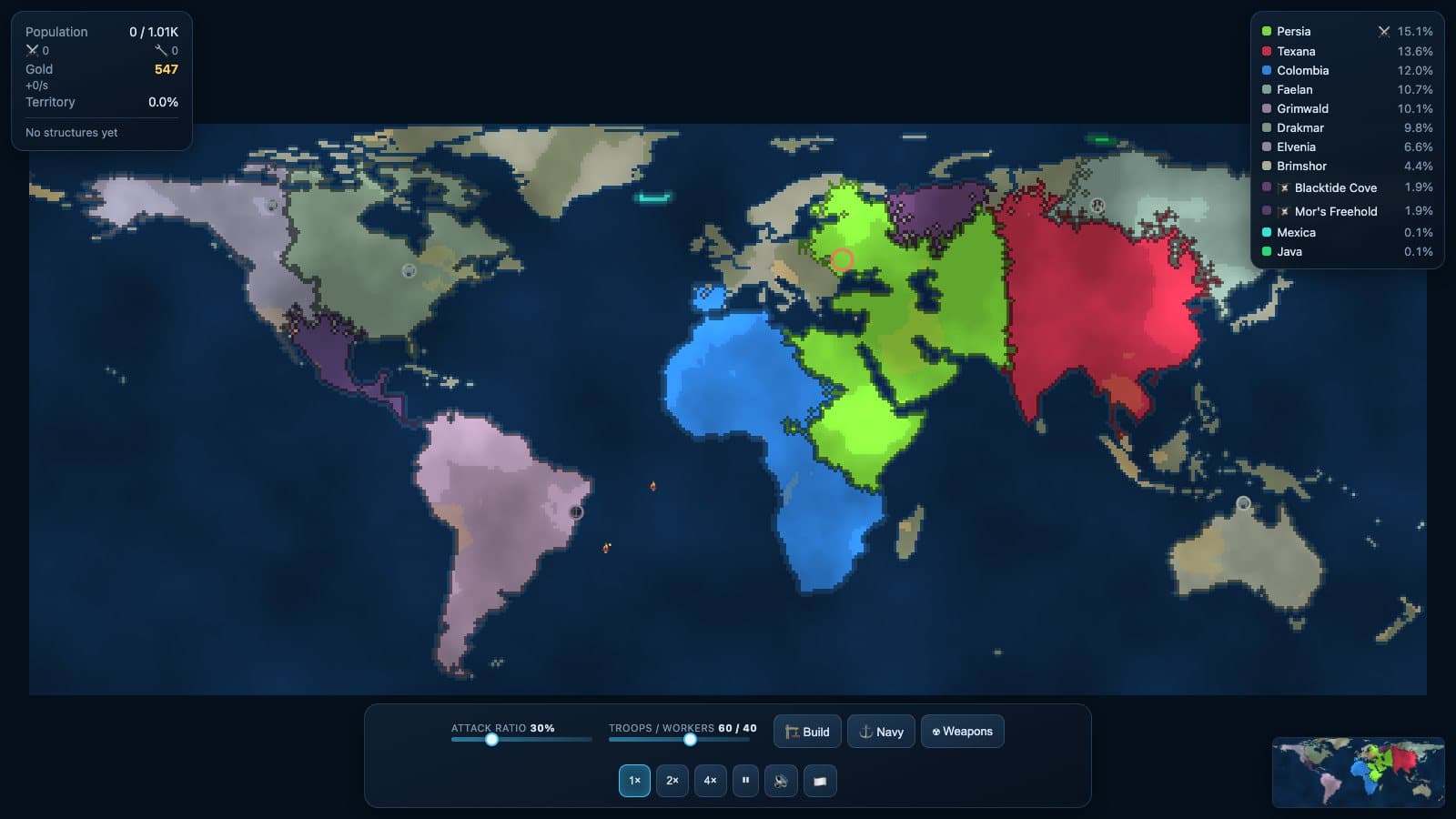
Your nation has one population. The Troops / Workers slider, which starts at 60/40 and moves from 10/90 to 95/5, only says how that one number is read. In game.js troops are population times the ratio and workers are population times one minus the ratio. Nobody is retrained or moved, so a change applies on the next tick.
That makes the slider free to move. The only price is the gold you stop earning while it sits high.
Population itself grows the way a textbook population model does: logistic growth, where growth is proportional to both what you have and the room left below a cap. The code multiplies growth by 1 - pop / maxPop, and the cap is what carrying capacity means: 1,000 plus 2.5 per tile, 3,500 per city and 8,000 for a capital. The slider has no say in any of it.
Ten points of slider cost 0.0011 gold per second per person
A worker earns 0.0011 gold per tick, which is 0.011 gold per second. Ten slider points move a tenth of your population, so the price is the same arithmetic at every size.
| Slider | Troops (pop 6,000) | Workers | Gold per second |
|---|---|---|---|
| 95/5 | 5,700 | 300 | 3.3 |
| 75/25 | 4,500 | 1,500 | 16.5 |
| 60/40 | 3,600 | 2,400 | 26.4 |
| 40/60 | 2,400 | 3,600 | 39.6 |
| 25/75 | 1,500 | 4,500 | 49.5 |
| 10/90 | 600 | 5,400 | 59.4 |
At a population of 10,000, ten points are 1,000 people, which is 11 gold per second or 660 a minute. Going from 75/25 to 40/60 at 6,000 population adds 23 gold per second. From workers alone, a city at 2,500 gold is then 63 seconds of income instead of 152. What to build first has the payback times.
In the opening, workers are a minor source anyway. Every tile you conquer pays 1.2 gold, and a nation at 95/5 that holds about 4,000 tiles has earned most of its gold that way.
The slider does not make you expand faster
This is the part that surprised us, because the game's own FAQ says to keep roughly 75% troops while expanding. We tested it on the real game code, and the test only works if the spending is the same on every row, so each simulated click sent 12% of the whole population, whatever the slider said.
| Slider | Attack slider for the same spend | Tiles, min 2 | Tiles, min 4 | Gold earned by min 4 | Attacked before min 4 | Alive at min 8 |
|---|---|---|---|---|---|---|
| 20/80 | 60% | 1,906 | 3,878 | 10,332 | 29 of 48 | 26 of 48 |
| 40/60 | 30% | 1,924 | 3,950 | 8,855 | 28 of 48 | 29 of 48 |
| 60/40 | 20% | 1,909 | 3,769 | 7,352 | 26 of 48 | 29 of 48 |
| 75/25 | 16% | 1,931 | 4,004 | 6,881 | 25 of 48 | 33 of 48 |
| 90/10 | 13% | 1,937 | 4,107 | 5,991 | 24 of 48 | 37 of 48 |
| 95/5 | 13% | 1,937 | 4,104 | 5,714 | 21 of 48 | 39 of 48 |
Land is the same row after row. Gold falls by 45% from the top row to the bottom. Survival climbs from 26 to 39 of 48.
So the slider is a dial between income and safety, and the land race is decided by something else: how much you send and how often.
Raise the troop slider and the attack slider has to come down
An attack sends your available troops times the attack ratio. The two sliders multiply, and the attack ratio defaults to 30%. A player who takes the FAQ's 75% and leaves the other slider alone sends 22.5% of the whole population per click instead of 12%.
We ran that too: one click every 5 seconds at the default 30% attack ratio.
| Slider | Population sent per click | Tiles, min 4 | Population, min 4 | Gold by min 4 | Alive at min 8 |
|---|---|---|---|---|---|
| 20/80 | 6% | 3,443 | 7,426 | 10,908 | 29 of 48 |
| 40/60 | 12% | 3,950 | 5,740 | 8,855 | 29 of 48 |
| 60/40 | 18% | 3,439 | 3,657 | 6,465 | 27 of 48 |
| 75/25 | 22.5% | 3,390 | 3,357 | 5,564 | 24 of 48 |
| 90/10 | 27% | 3,333 | 2,884 | 4,912 | 25 of 48 |
| 95/5 | 28.5% | 3,387 | 2,489 | 4,836 | 23 of 48 |
Same 95/5, different attack slider: 23 survivors instead of 39, and less land. The 40/60 row is identical in both tables because it sends 12% either way. The troops you send are gone from home. A population drained to 2,489 has few troops left to hold anything.
The fix costs nothing: pull the attack ratio down as the troop slider goes up, so one click stays near 12% to 16% of your population.
A low slider makes you the cheapest neighbor
The cost of taking a nation's land reads the defender's available troops twice, in the density term and in the outnumbered term. Fewer troops, cheaper tiles. We replayed the formula for a nation of 500 tiles and 8,000 population at minute 10 and searched for the smallest single attack that takes all of it.
| Defender slider | Defender troops | Attack needed | Per tile owned |
|---|---|---|---|
| 95/5 | 7,600 | 10,751 | 21.5 |
| 75/25 | 6,000 | 10,024 | 20.0 |
| 60/40 | 4,800 | 9,231 | 18.5 |
| 40/60 | 3,200 | 7,720 | 15.4 |
| 25/75 | 2,000 | 6,001 | 12.0 |
| 10/90 | 800 | 3,501 | 7.0 |
Moving from 75/25 to 40/60 makes you 23% cheaper to conquer and multiplies your worker income by 2.4 (16.5 to 39.6 gold per second at 6,000 population). That is a fair trade when nobody is close. Against a neighbor it is the reason you get picked.
The AI chooses its target by the lowest score of the other nation's troops divided by the shared border length plus 4, and the score of a human is multiplied by 0.55 so nations "hunt players", in the words of the code comment. A nation bordering you also takes a swing on its own clock whenever its available troops exceed yours by 12%. On Normal that is a 5.8% roll at each of its decisions, one every 1.8 to 3.6 seconds, mostly once it has no free land left to grab.
A big push needs a high slider for a few seconds
Taking a whole nation costs 1.5 to 1.75 times its garrison in one attack, and raids waste troops. The largest single push you can make is your population times the troop slider, sent at 100%. So the slider sets which nations you are able to eat.
| Their population | Their troops | Push needed | Slider needed at your pop 8,000 | at 16,000 | at 32,000 |
|---|---|---|---|---|---|
| 4,000 | 3,000 | 5,262 | 66% | 33% | 17% |
| 8,000 | 6,000 | 10,024 | cannot | 63% | 32% |
| 16,000 | 12,000 | 18,786 | cannot | cannot | 59% |
The target is 500 tiles at minute 10, at the AI's default 75% troops. A nation of 8,000 people is out of reach for an 8,000-person nation in a single push at any setting, which is why growth comes before war. A nation of 32,000 people takes the same 8,000-person nation with about a third of its population in the attack.
The slider is the instrument for this. Hold workers high while you earn, raise it to the number in the table, send 100%, and lower it again.
What the game's own nations do
The AI uses the same slider, which is a good sanity check on the 75% line in the FAQ.
| Nation type | Troop share |
|---|---|
| Nation, free land next to it or at war | 75% |
| Nation, at peace | 55% |
| Settler, grabbing land | 72% |
| Settler, no free land | 50% |
| Settler, over 18% of the map | 45% |
| Pirate | 70% |
| Zombie horde | 90% |
The nations also never empty the house. They commit troops only out of the population above 35% of their cap, because, as the comment in ai.js puts it, "a nation whose whole military is out grabbing dirt is a free kill for any player who wanders past". The attack slider is how you copy that: the troops that stay home are the ones that keep your tiles expensive.
Where to start
Open a match on the Frontlines game page and look at the two sliders at the bottom. Try 75/25 with the attack ratio at 16% for the first four minutes, then drop to 40/60 when your borders stop moving. The FAQ has the rest of the controls. Gold is also what pays for the late game: a nuke is 18,000, and the SAM post works out how many 10,000-gold sites it takes to stop one.
More from the blog.
Frontlines Trade Ships: How Much Gold a Trader Earns
A trader costs 800 gold and earns about 830 gold a minute on a typical 120-tile route. Payback, the port ladder and the catch, replayed from the game code.
Oct 15, 2026 · 6 min
What to Build First in Frontlines
A city pays for itself in 3 minutes 25 seconds, a factory in 5 minutes 35. The build order for your first ten minutes, with numbers from the game code.
Oct 03, 2026 · 5 min
How Alliances Work in Frontlines, and What Betrayal Costs
A solo alliance lasts 10 minutes. Leaving gives a 5-minute truce, betraying makes you 35% easier to conquer for good. Every number from the game code.
Oct 13, 2026 · 5 min