How Many SAMs Stop a Nuke in Frontlines
One SAM stops one missile, then waits 30 seconds. Costs, the 15-tile range and why a 4,500-gold rocket can beat a 10,000-gold SAM, from the game code.
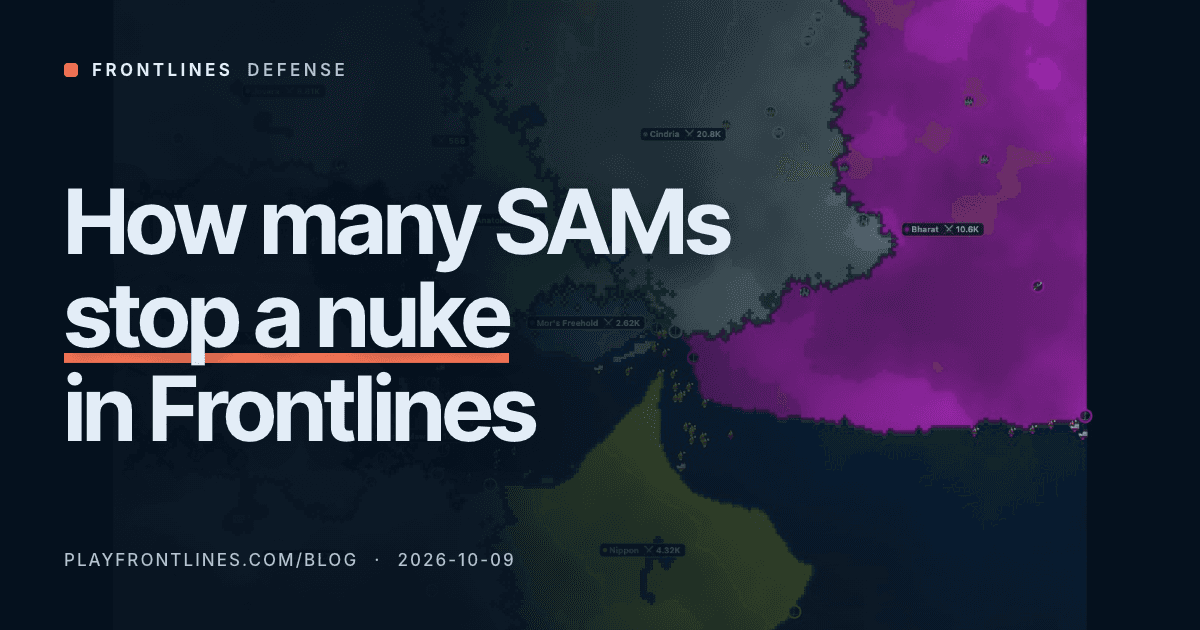
One SAM stops one missile, then needs 30 seconds to reload. It has to stand within 15 tiles of where the missile is going.
So the number you need is the number of missiles that can arrive inside the same 30 seconds. Against the AI that is one. Against a player with money it is as many nukes as they can pay for, plus whatever cheap rockets they throw in first.
This page has the costs, the ranges and the one trick that makes a single SAM look worse than it is, all taken from the game code and replayed in a script.
A SAM works alone and cannot be aimed
You build a SAM on your own land and forget it. Each tick, every missile in flight checks for SAMs. A SAM fires if it is off cooldown, the missile is inside its 15-tile circle and the missile has flown at least a fifth of its route. The hit removes one hit point from the missile. A missile with none left is gone before it detonates.
Two details from tryIntercept in game.js matter in practice:
- A SAM fires at any missile from a nation that is not allied with the SAM's owner, whoever the target is. A neighbor's SAM can stop a missile that was meant for you.
- Rockets, nukes and H-bombs have 1 hit point. A doomsday device has 2.
The in-game tooltip says the same thing in one line: "Intercepts one incoming missile, then recharges (30s cooldown)." The FAQ adds the standing advice: build SAMs before silos if a rival already went nuclear.
A SAM within 15 tiles of the target stops it
Range is measured to wherever the missile is, and the last place a missile is, is its target. So any SAM within 15 tiles of the aim point sees the missile at least on the final tick. A SAM farther away still helps if it sits near the flight line, because it gets a look at the missile on the way in.
We replayed one nuke over a 120-tile flight with a single SAM in different places.
| SAM position | Distance from the aim point | Result |
|---|---|---|
| On the target | 0 | stopped |
| To the side | 14 | stopped |
| To the side | 15 | stopped |
| To the side | 16 | lands |
| On the flight line, short of the target | 40 | stopped |
| Beyond the target | 20 | lands |
| To the side | 20 | lands |
The blast radius of a nuke is 11 tiles and the SAM radius is 15. That gap gives a placement rule: put the SAM 12 to 15 tiles from the thing you want to protect, such as your capital. It still covers the target, and if a missile gets through anyway, the SAM sits outside the crater. Inside 11 tiles it is erased with everything else.
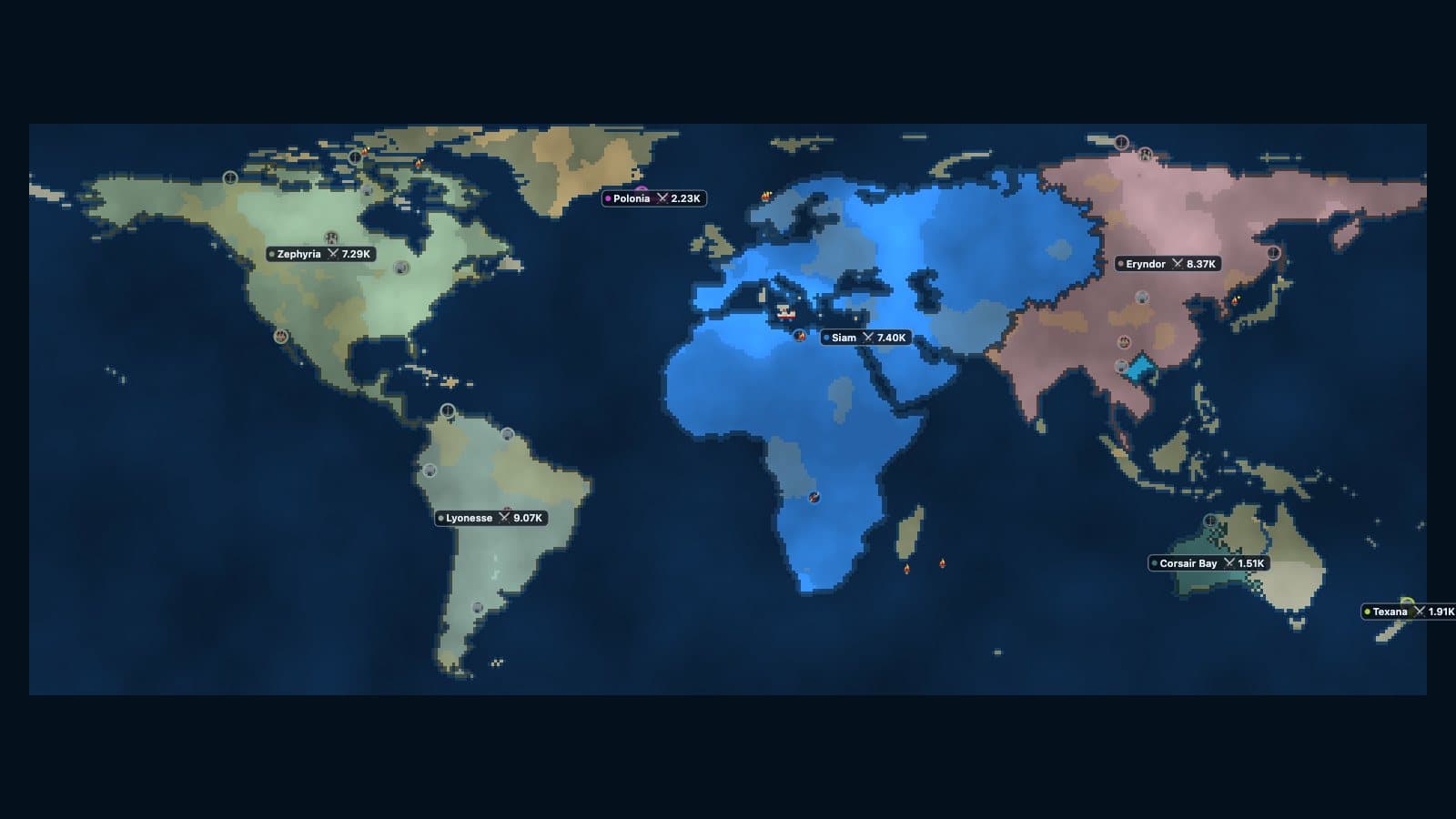
Flight time is too short to react
A missile flies 3.2 tiles per tick, which is 32 tiles per second. Across a 300-tile route that is 9.4 seconds, and a 100-tile route takes 3.2 seconds. The SAM does all the work. The game warns you when an AI fires at you, but there is nothing to do with those seconds except watch.
Two nukes at once need two SAMs
When several missiles arrive together, each SAM can take exactly one. We fired salvos at SAMs standing on the target.
| Attack | SAMs | Result | Attacker spends | You spend on SAMs |
|---|---|---|---|---|
| 1 nuke | 1 | stopped | 18,000 | 10,000 |
| 2 nukes together | 1 | one lands | 36,000 | 10,000 |
| 2 nukes together | 2 | both stopped | 36,000 | 24,000 |
| 3 nukes together | 2 | one lands | 54,000 | 24,000 |
| 3 nukes together | 3 | all stopped | 54,000 | 42,000 |
| H-bomb | 1 | stopped | 180,000 | 10,000 |
| Doomsday | 1 | lands | 900,000 | 10,000 |
| Doomsday | 2 | stopped | 900,000 | 24,000 |
The pattern is simple: to stop a salvo of N you need N SAMs, and the attacker needs N+1 missiles to get one through. The price of a SAM climbs by 40% of its base price with every copy you own (10,000, 14,000, 18,000, 22,000, 26,000, 30,000), because the game multiplies SAM, defense post and silo prices by 1 plus 0.4 per copy already owned. Weapons are flat: the tenth nuke costs the same 18,000 as the first.
That gives the defender the better side of the trade for a while. To force one nuke past six SAMs (120,000 gold spent) an attacker needs seven nukes, 126,000 gold, before paying for the silo. At seven SAMs (154,000) the attacker needs eight nukes (144,000) and the math flips. Few matches reach those numbers, but it shows where more SAMs stop being the efficient answer. Past that point a sensible split is to stop adding SAMs and spend the gold on troops instead, since an attack on the nation holding the silo is what removes the threat for good.
A rocket can drain your SAM first
This is the part that surprises people. A SAM reloads for 30 seconds, and a rocket costs 4,500 gold. The rocket has 1 hit point like everything else, so it uses up the SAM's shot just as well as a nuke would.
In our replay, a rocket fired first and a nuke fired 5 seconds later against one SAM: the rocket was stopped and the nuke landed. The same pair 29 seconds apart: the nuke landed again. At 31 seconds apart the SAM was ready and stopped it. The pair cost the attacker 22,500 gold against your 10,000.
The bait gets cheaper the more SAMs you own, because the next SAM costs more while the rocket stays at 4,500.
| SAMs you own | Price of your next SAM | Rocket as share of that price |
|---|---|---|
| 0 | 10,000 | 45% |
| 1 | 14,000 | 32% |
| 2 | 18,000 | 25% |
| 3 | 22,000 | 20% |
| 4 | 26,000 | 17% |
Two rockets and a nuke beat two SAMs the same way. Rockets are not a free win for the attacker: the code comment calls the rocket an "entry-level missile: small blast, no city-breaker", and it still costs a silo and gold. But when you are counting SAMs against a player, count their rockets as missiles too.
The AI fires slowly and aims at your middle
You will meet the AI's missiles far more often than a human's. The relevant code is nationWeapons in ai.js:
- Easy nations never fire missiles. Normal and Hard nations do.
- The AI builds a silo once it holds 4% of the land and no longer borders unclaimed land.
- It fires only at its biggest non-allied rival, and only if that rival holds more than 1.5 times its own tiles. It tries a doomsday device first, then an H-bomb, then a nuke, and uses the first one it can afford.
- It waits 2,500 ticks, which is 250 seconds, between launches.
- It aims at the center of your territory plus or minus about 6 tiles. If that spot is not yours, it searches outward for your nearest tile.
- The code never fires rockets.
So one SAM within 15 tiles of the middle of your land covers an AI nuke every time, since 250 seconds is more than eight reloads. If you hold half again as many tiles as an AI nation, you are its target, and that AI builds up to two SAMs of its own when a rival owns a silo.
You can see who is a threat without guessing: hover a nation and the tooltip lists its silo count next to its cities and factories. A rival with a silo and 18,000 gold is a rival with a nuke. The build-order guide covers how fast the gold arrives.
What lands if the SAM misses
A nuke removes ownership from every land tile within 11 tiles of the impact. That is at most 377 tiles, about 0.5% to 1.4% of all land on the World, Europe, USA, Hormuz, Germany and Pangaea maps at normal size. Every building on those tiles is deleted. If the capital is one of them, your defense drops 20% for 30 seconds, and the 15,000 gold you spent on it is gone. You also lose 4 population for every tile you lost, up to 1,508.
| Weapon | Gold | Blast radius | Tiles in a full blast | Population lost at most |
|---|---|---|---|---|
| Rocket | 4,500 | 5 | 81 | 324 |
| Nuke | 18,000 | 11 | 377 | 1,508 |
| H-bomb | 180,000 | 22 | 1,517 | 6,068 |
| Doomsday | 900,000 | whole nation | all | whole nation |
The attacker does not get the land. The tiles become unclaimed, with fallout for 30 seconds that makes them 1.5 times as costly to take. Whoever has troops standing nearby grabs them after. That is why a nuke on a border, followed by an attack, is the combination to fear: the empty tiles cost 1.5 troops each to walk into, against 4 to 19 for a defended tile in the troop-cost numbers.
The config comment puts the nuke at "~7 cities". The comment above the weapon prices calls them "late-game superweapons, not spam".
OpenFront's SAMs work differently
If you play OpenFront as well, do not carry these numbers over. We read the SAM launcher code in the OpenFront repository and it is a different system: its SAM launchers have upgrade levels, compute their range dynamically, and target atom bombs, hydrogen bombs and MIRV warheads, in SAMLauncherExecution.ts. We make Frontlines and CONQUEST, not OpenFront. Check its own rules before relying on anything here.
When you want to test the Frontlines numbers, start a match on Normal, build a silo and one SAM, and watch what the nearest AI does to the biggest nation.
More from the blog.
Frontlines Trade Ships: How Much Gold a Trader Earns
A trader costs 800 gold and earns about 830 gold a minute on a typical 120-tile route. Payback, the port ladder and the catch, replayed from the game code.
Oct 15, 2026 · 6 min
How Alliances Work in Frontlines, and What Betrayal Costs
A solo alliance lasts 10 minutes. Leaving gives a 5-minute truce, betraying makes you 35% easier to conquer for good. Every number from the game code.
Oct 13, 2026 · 5 min
Troops vs Workers in Frontlines: Where to Set the Slider
The slider does not change how fast you expand. It trades gold for defense: 95/5 earned 45% less than 20/80 but survived 39 of 48 matches, not 26.
Oct 11, 2026 · 6 min