How Many Troops to Conquer a Nation in Frontlines
Send about 1.5 to 1.75 times a nation's troops. Enemy land costs 4 to 19 troops per tile against 1 for empty land. The numbers, from the game code.
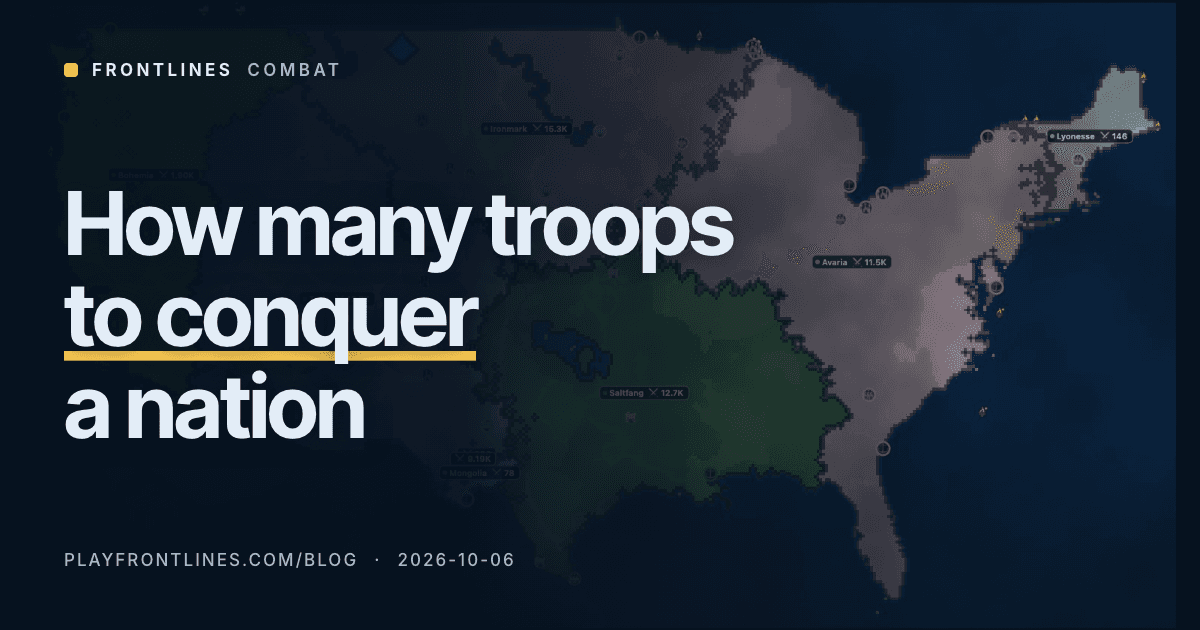
Send about 1.5 to 1.75 times the troops you see over a nation, in one attack.
That is the cost of taking a whole nation on plains at about minute 10. A nation with 5,000 troops falls to 8,550. One with 15,000 falls to 24,000. Empty land is a different deal: it costs 1 troop a tile, and enemy land costs between 4 and 19.
This page shows where those numbers come from, and the four things that move them: how many troops you send at once, terrain, defense posts and the clock.
Every enemy tile has a price
An attack in Frontlines is a pool of troops that buys tiles one at a time. The pool is your available troops (population times the Troops slider) times the attack ratio slider. When the pool cannot pay for the next tile, the attack ends and whatever is left goes home. The FAQ on the game page gives the idea. The formula itself is in game.js, and here it is in full.
For a tile that belongs to a nation:
- Start from 1.5 troops. That is the floor, set so that, in the words of the code comment, nations "should not fold to a 30% poke".
- Add 0.7 for every troop the defender has per tile it owns. This is the density term. A nation with 5,000 troops on 500 tiles has a density of 10, so it adds 7.
- Add 1.8 for every time the defender's troops outnumber your attack, counting up to 3 times. This is the term that punishes small attacks.
- Multiply by the terrain: 1 for plains, 1.9 for mountains, 1.75 for desert. Nuclear fallout adds another 1.5 times.
- Multiply by any defense posts near the tile.
Empty land skips everything except the terrain. That is why the opening land grab is so cheap and why the first border war feels like walking into a wall.
The number over a nation on the map, the sword icon and a figure, is exactly the troop count that formula uses.
The size of your attack changes the price per tile
The third term is the one players do not see. We computed the price of the first plains tile for a defender on 500 tiles at minute 10, sending different amounts.
| Defender troops | You send | Troops per tile |
|---|---|---|
| 2,000 | 1,000 | 7.22 |
| 2,000 | 10,000 | 4.38 |
| 5,000 | 1,000 | 12.77 |
| 5,000 | 5,000 | 9.62 |
| 5,000 | 20,000 | 8.44 |
| 10,000 | 1,000 | 19.40 |
| 10,000 | 20,000 | 15.45 |
Against a 5,000-troop nation, a 20,000-troop attack pays about a third less per tile than a 1,000-troop one. The density term does not care how many you send. The outnumbered term does.
The code comment above that term calls it a home-soil advantage: outnumbered attacks stall. This is the stall. A poke is expensive for what it buys, so it ends early and leaves the defender with its garrison almost intact.
A whole nation costs 1.5 to 1.75 times its garrison
We searched for the smallest single attack that takes every tile of a nation at minute 10.
| Nation's tiles | Nation's troops | You must send | Times their troops | Seconds |
|---|---|---|---|---|
| 100 | 800 | 1,400 | 1.75x | 2.7 |
| 300 | 3,000 | 5,100 | 1.70x | 2.6 |
| 500 | 5,000 | 8,550 | 1.71x | 2.8 |
| 800 | 8,000 | 13,750 | 1.72x | 3.6 |
| 300 | 10,000 | 15,150 | 1.51x | 1.3 |
| 500 | 15,000 | 24,000 | 1.60x | 2.1 |
| 1,000 | 30,000 | 46,900 | 1.56x | 4.0 |
The ratio holds between 1.5 and 1.75 across every size we tried. Two things follow.
A dense small nation is the expensive target. Three hundred tiles with 10,000 troops costs 50.5 troops per tile. Eight hundred tiles with 8,000 troops costs 17.2. The FAQ makes the same point: dense little nations are expensive to crack, sprawling giants are cheap per tile.
And a whole-nation attack is over in seconds. The code takes up to 25 tiles per tick, which is 250 tiles a second, and a bigger army moves faster. You are not besieging anything. You either have enough troops for the burst or you do not.
Raids waste troops
Splitting an attack looks safe and is not. We gave one attacker 20,000 troops to spend against a 500-tile, 5,000-troop nation, either all at once or in equal raids.
| How the 20,000 is spent | Tiles taken | Troops that come home |
|---|---|---|
| One push of 20,000 | 500 | 12,643 |
| 2 raids of 10,000 | 500 | 12,159 |
| 4 raids of 5,000 | 500 | 8,863 |
| 10 raids of 2,000 | 500 | 4,338 |
All four take the nation, since there is no regrowth in the replay and the garrison keeps bleeding. What differs is the bill. Ten small raids spend 15,662 troops. One push spends 7,357.
A second attack on the same target while the first is still running merges into it, so you can top up an attack in progress without paying the small-force price. The penalty is for raids that end and start again.
Defense posts stop pokes, not pushes
A defense post multiplies the cost of every tile within 8 tiles of it by 1.6. A second post inside the same radius brings the total to 2.4, and that is the cap. A third changes nothing. A post takes 8 seconds to finish and counts for nothing until then, so it will not save a border that is already under attack.
The first post costs 3,000 gold, and each further one costs 40% more than the base price again, so the second is 4,200.
Here is 5,000 attacking troops against the same 500-tile nation.
| Posts covering the tile | Tile cost multiplier | Tiles taken |
|---|---|---|
| 0 | 1.0x | 361 |
| 1 | 1.6x | 260 |
| 2 | 2.4x | 186 |
| 3 | 2.4x | 186 |
Posts matter a lot against a force that is barely strong enough. Against an overwhelming one they matter little: the smallest attack that takes all 500 tiles rises only from 8,550 to 9,300 with posts everywhere (9,400 with two overlapping). The defender's garrison dies faster when every tile costs more, and a dead garrison makes the rest cheap.
So a post is a reason for the attacker to wait and bring more, not a wall. Build them where an enemy would have to commit, and read what to build first before spending 3,000 gold on one.
Three moments when a nation is cheaper
The density and outnumbered terms are multiplied by a stance factor. It is 1 for a normal nation and lower in three cases.
| Defender state | Factor | Tiles taken with 5,000 troops |
|---|---|---|
| Normal | 1.00 | 361 |
| Lost its capital in the last 30 seconds | 0.80 | 403 |
| Betrayer, or attacked an ex-ally in the surprise window | 0.65 | 437 |
| Both | 0.52 | 466 |
A betrayer defends 35% worse permanently. A surprise attacker defends 35% worse for 5 minutes. If a neighbor has just broken an alliance to hit you, that is the moment to hit them back.
Time is on the attacker's side, slowly
Two things loosen a standoff as the match goes on. The code comments give the reason. The ratio shield decays "otherwise two equal superpowers freeze at 50/50 forever and nobody ever wins". War exhaustion exists so that a winner can emerge.
The effect over a match is real but small.
| Game minute | Troops needed for the 500-tile, 5,000-troop nation |
|---|---|
| 2 | 8,700 |
| 10 | 8,550 |
| 30 | 8,250 |
| 45 | 8,000 |
| 75 | 7,150 |
Compared with minute 2, that is 8% cheaper by minute 45, when a Normal match ends on the clock, and 18% cheaper by minute 75. The clock is not what wins a war. The number you send is.
Where the textbook model does not apply
The textbook answer to "how many do I need" is Lanchester's square law, which says that the power of a force is proportional to the square of the number of units. Frontlines does not use it. The price per tile grows linearly with how outnumbered you are, up to 3 times, so doubling your army does not quadruple its punch. It just makes each tile cheaper.
You can start a match and check the figure yourself: pick a neighbor, read the number over it, and send 1.6 times as much.
More from the blog.
Frontlines Trade Ships: How Much Gold a Trader Earns
A trader costs 800 gold and earns about 830 gold a minute on a typical 120-tile route. Payback, the port ladder and the catch, replayed from the game code.
Oct 15, 2026 · 6 min
How Alliances Work in Frontlines, and What Betrayal Costs
A solo alliance lasts 10 minutes. Leaving gives a 5-minute truce, betraying makes you 35% easier to conquer for good. Every number from the game code.
Oct 13, 2026 · 5 min
Troops vs Workers in Frontlines: Where to Set the Slider
The slider does not change how fast you expand. It trades gold for defense: 95/5 earned 45% less than 20/80 but survived 39 of 48 matches, not 26.
Oct 11, 2026 · 6 min