Frontlines Trade Ships: How Much Gold a Trader Earns
A trader costs 800 gold and earns about 830 gold a minute on a typical 120-tile route. Payback, the port ladder and the catch, replayed from the game code.
A trader costs 800 gold and earns 60 gold plus 2.5 gold per tile between the two ports it sails. On the 120-tile route a typical rival port gives you, that is about 830 gold a minute, so it pays for itself in about a minute.
Each port lets you run two. A port plus two traders is a 4,100-gold purchase that returns about 1,650 gold a minute. A 3,000-gold factory returns 540.
The rest of this page is where those numbers come from, what decides the distance, and the three ways the income goes away.
A leg pays 60 gold plus 2.5 per tile
A trader sails back and forth between two ports on its own. You never steer it. Every time it arrives, it is paid for the cargo it loaded at the other end, then loads the next one:
- Cargo per leg: 60 + 2.5 x the gap between the two ports in tiles (counted along the axes, not diagonally).
- Speed: 0.5 tiles per tick, which is 5 tiles per second.
- The first leg is empty. A new trader sails out unloaded and only picks up cargo at the far port, so the first payout comes after one full round trip.
Paper values, assuming the ship sails a straight line:
| Gap between ports (tiles) | Gold per leg | Seconds per leg | Gold per minute |
|---|---|---|---|
| 10 | 85 | 2.0 | 2,550 |
| 40 | 160 | 8.0 | 1,200 |
| 80 | 260 | 16.0 | 975 |
| 120 | 360 | 24.0 | 900 |
| 160 | 460 | 32.0 | 863 |
Close ports win on gold per minute, because the flat 60 gold per leg is paid more often. Far ports win on gold per leg, which matters little: the ship is the same 800 gold either way.
We ran the real game to check
Paper is not a result, so we ran the real Game class from the game code, headless. Setup: Earth map, two nations, the AI frozen so nobody attacks or captures anything, and income counted with the game's own trade hook so worker income cannot leak in. Ports went on two coastal tiles of the same sea at a chosen gap, one trader, ten minutes. The script is scripts/research/frontlines-traders.mjs in the blog repository.
| Gap (tiles) | Sea path (tiles) | First payout | Gold per minute | Pays back 800 after |
|---|---|---|---|---|
| 10 | 10 | 4 s | 2,542 | 0.3 min |
| 40 | 38 | 15 s | 1,232 | 0.6 min |
| 80 | 82 | 33 s | 910 | 0.9 min |
| 120 | 122 | 49 s | 828 | 1.0 min |
| 160 | 242 | 97 s | 506 | 1.6 min |
The 160-tile pair is the one place where paper and game disagree: land sits between the two ports, so the sea path is 242 tiles for a 160-tile gap. Pay is by gap, time is by path, and a detour costs you.
Two traders earn exactly double, at every gap. A third is refused: the fleet cap is 2 per port.
The partner is the nearest rival port, not your second port
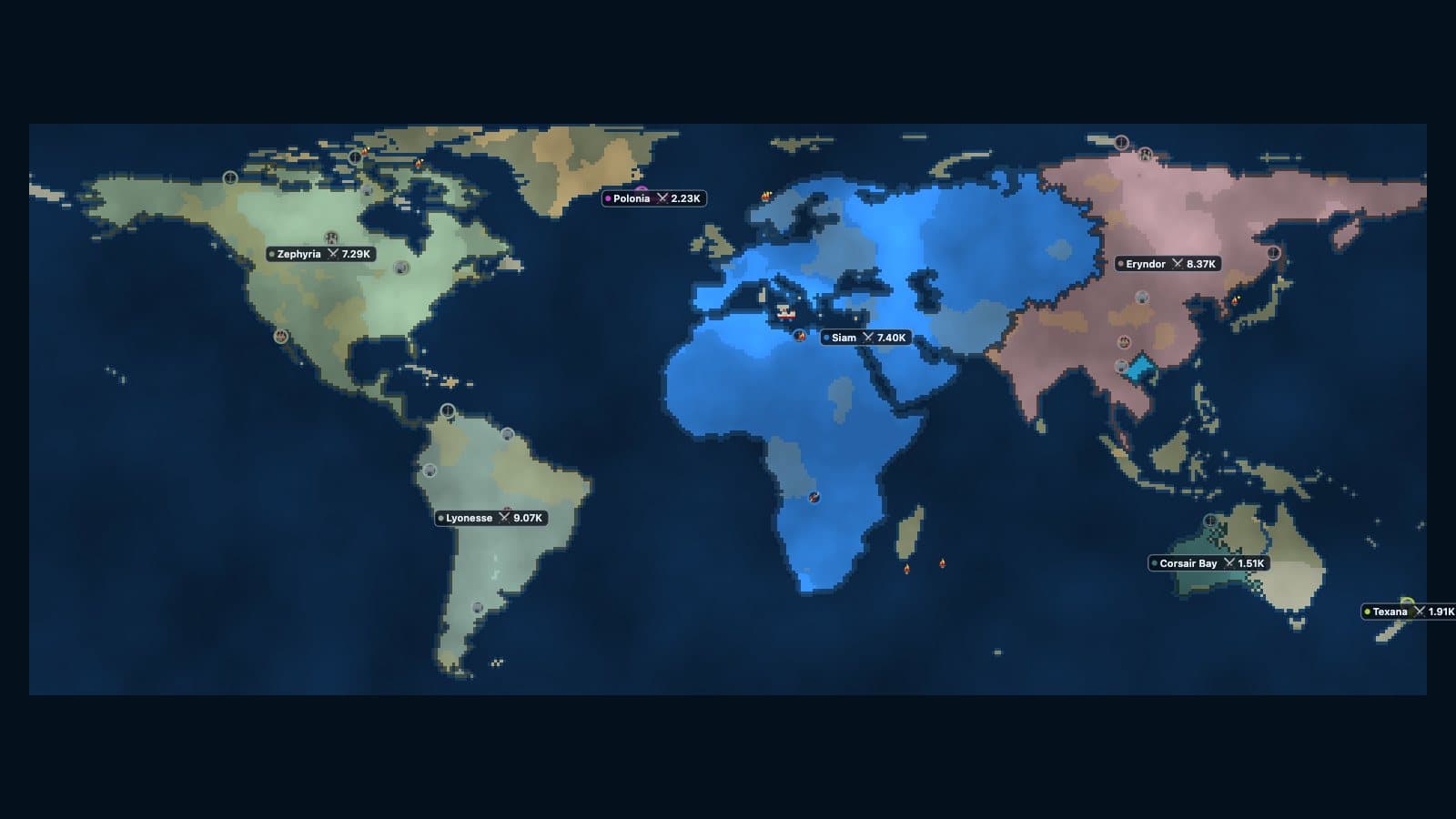
This is the rule that surprises people. When a trader picks a destination, pickTradeRoute in naval.js looks at every port on the same sea and falls through three cases:
- Ports of other nations that are not at war with you. Allies and neutral nations count. The nearest one wins.
- Your own other ports. Used only if group 1 is empty.
- Nothing. The trader sails a coastal loop instead.
The first case always beats the second, however much closer your own port is. Building a second port next to your first does not give you a short route if a rival port exists on that sea. It only raises the fleet cap.
"At war" is narrower than it sounds. A nation counts as an enemy if you fought it within the last 60 seconds or an attack is running between you. Stop attacking and the port comes back into your trade list a minute later. If you want the rules for who is an ally and what leaving costs, they are in how alliances work in Frontlines.
| Situation | What one trader does | Gold in 10 minutes (our replay) |
|---|---|---|
| Rival port, 120 tiles away | Sails to it and back | 8,280 |
| No rival port, two of your own, 120 tiles apart | Same route | 8,280 |
| One port, nothing else on the sea | Coastal loop | 1,014 to 3,148 |
The loop goes to a random point 22 to 60 tiles from your harbor and pays 60 gold plus 2 gold per tile of distance, once, when it gets home. In eight random-number seeds that was 100 to 315 gold a minute. Still positive, still more than the ship cost in under 10 minutes, but a fraction of a real route.
Rival ports sit 100 to 160 tiles away
You do not choose the gap, so what matters is the usual one. We played 12 full matches on each of three maps with 9 AI nations on Normal, and at minute 12 measured, for every port, the distance to the nearest port of a different nation on the same sea.
| Map | Median gap | Middle half of ports | Ports with no rival on their sea |
|---|---|---|---|
| Earth | 126 tiles | 85 to 161 | 1 of 52 |
| Europe | 100 tiles | 70 to 130 | 17 of 83 |
| USA | 162 tiles | 93 to 210 | 0 of 67 |
So plan on 500 to 900 gold a minute per trader, with Europe the best of the three and the lonely-port case there worth knowing about: 17 ports had no rival on their sea at minute 12, and those traders earn the loop rate.
Compared with income you already know: a worker produces 0.011 gold per second, so two traders at 1,650 gold a minute match about 2,500 workers, without spending a single person on it. How the worker side of that slider works is covered in troops versus workers.
Each extra port pays back in 3 to 5 minutes
Port prices climb 50% per copy for the first three, then 100%, the same escalation as cities and factories. The full cost table is in what to build first. Each port adds room for two traders, so the real price of the next step is the port plus 1,600 gold of ships. At a 120-tile gap, measured at 828 gold a minute per trader:
| Port number | Port + 2 traders | Extra gold per minute | Pays back after | Factory of the same number | Pays back after |
|---|---|---|---|---|---|
| 1 | 4,100 | 1,656 | 2.5 min | 3,000 | 5.6 min |
| 2 | 5,350 | 1,656 | 3.2 min | 4,500 | 8.3 min |
| 3 | 6,600 | 1,656 | 4.0 min | 6,000 | 11.1 min |
| 4 | 7,850 | 1,656 | 4.7 min | 7,500 | 13.9 min |
Two things keep that from being a free lunch. Trade income is added straight to your gold, so the city, factory, railway and capital multipliers do not touch it. And a port needs coast: the in-game tooltip says rivers that reach the sea count, but a landlocked nation has no trade at all.
The income disappears in three ways
The partner gets paid too. Whenever your loaded trader arrives at a port that belongs to someone else, the owner receives half of that leg's cargo. In our replay at a 120-tile gap that was 1,980 gold to the partner against 8,280 to you, about 24%. If that partner is the nation you are about to fight, part of your trade is funding its economy. Your own ports and the coastal loop pay nobody.
Armed ships take traders. A warship or carrier whose owner is not your ally spots a trader within 8 tiles, chases it, and captures it at 3 tiles. The ship then trades for its new owner. Neutral nations do this too, not only enemies. Traders have 20 hit points and no defense. In our 12 matches per map, with the AI playing normally and pirates present, 2.5 trade ships were seized per match on Earth, 7.1 on Europe and 16.5 on USA by minute 12, against 7 to 13 traders afloat at that time. That is all nations combined, not just yours. Because a trader pays for itself in about a minute, one that lives for three minutes has already made its money back twice, but a coast with pirates next to it is where to buy a warship before the third trader.
War cuts the route. Start a fight with your partner and its port drops off your list for as long as the fight lasts. Your traders fall back to your own ports or to the loop, and income falls to the figures in the table above.
What to do with this
Build a port as soon as you own coast and have 2,500 gold you are not about to spend on a city, then two traders at once (the R key buys a trader). That is the cheapest payback in the build list. Add a second port whenever gold is sitting idle, since the next one still pays back in about three minutes, and put a warship near the harbor when your sea has pirates. The game's own FAQ says the same in one line: never leave your coast portless. You can try the numbers in a solo match at playfrontlines.com.
More from the blog.
Troops vs Workers in Frontlines: Where to Set the Slider
The slider does not change how fast you expand. It trades gold for defense: 95/5 earned 45% less than 20/80 but survived 39 of 48 matches, not 26.
Oct 11, 2026 · 6 min
What to Build First in Frontlines
A city pays for itself in 3 minutes 25 seconds, a factory in 5 minutes 35. The build order for your first ten minutes, with numbers from the game code.
Oct 03, 2026 · 5 min
How Alliances Work in Frontlines, and What Betrayal Costs
A solo alliance lasts 10 minutes. Leaving gives a 5-minute truce, betraying makes you 35% easier to conquer for good. Every number from the game code.
Oct 13, 2026 · 5 min