Railway or Airport in Frontlines: When Boosters Pay Off
A railway adds 4% gold for 3,500 gold, an airport 7% for 7,000. We computed the payback: 41 minutes at 600 tiles, 5 minutes at 10,000.
Do not build a railway or an airport in your first ten minutes. A railway costs 3,500 gold and adds 4% to your gold and growth. An airport costs 7,000 and adds 7%. A small nation makes about 35 gold per second, so 4% of that takes 41 minutes to pay back, and the clock on a Normal world is 45.
They turn into good buys once your base income passes roughly 100 gold per second. A nation holding 10,000 tiles earns a railway back in 5 minutes.
Everything below comes from config.js and game.js in the game code, and the payback tables come from a script that imports those numbers directly, so a rebalance changes the output.
The multiplier is one number with three sources
Population growth and gold income both multiply by a single value, 1 + boost, capped at 1.6. The capital adds 0.25. Each working railway adds 0.04 and each working airport adds 0.07. Gold per tick is (workers x 0.0011 + factories x 0.9) x multiplier, and a tick is a tenth of a second.
That makes a booster's gain simple: it is 4% or 7% of whatever your base income already is. A railway does nothing for a nation with no workers and a lot for one with a million of them. That is why the answer depends on your size and not on the building.
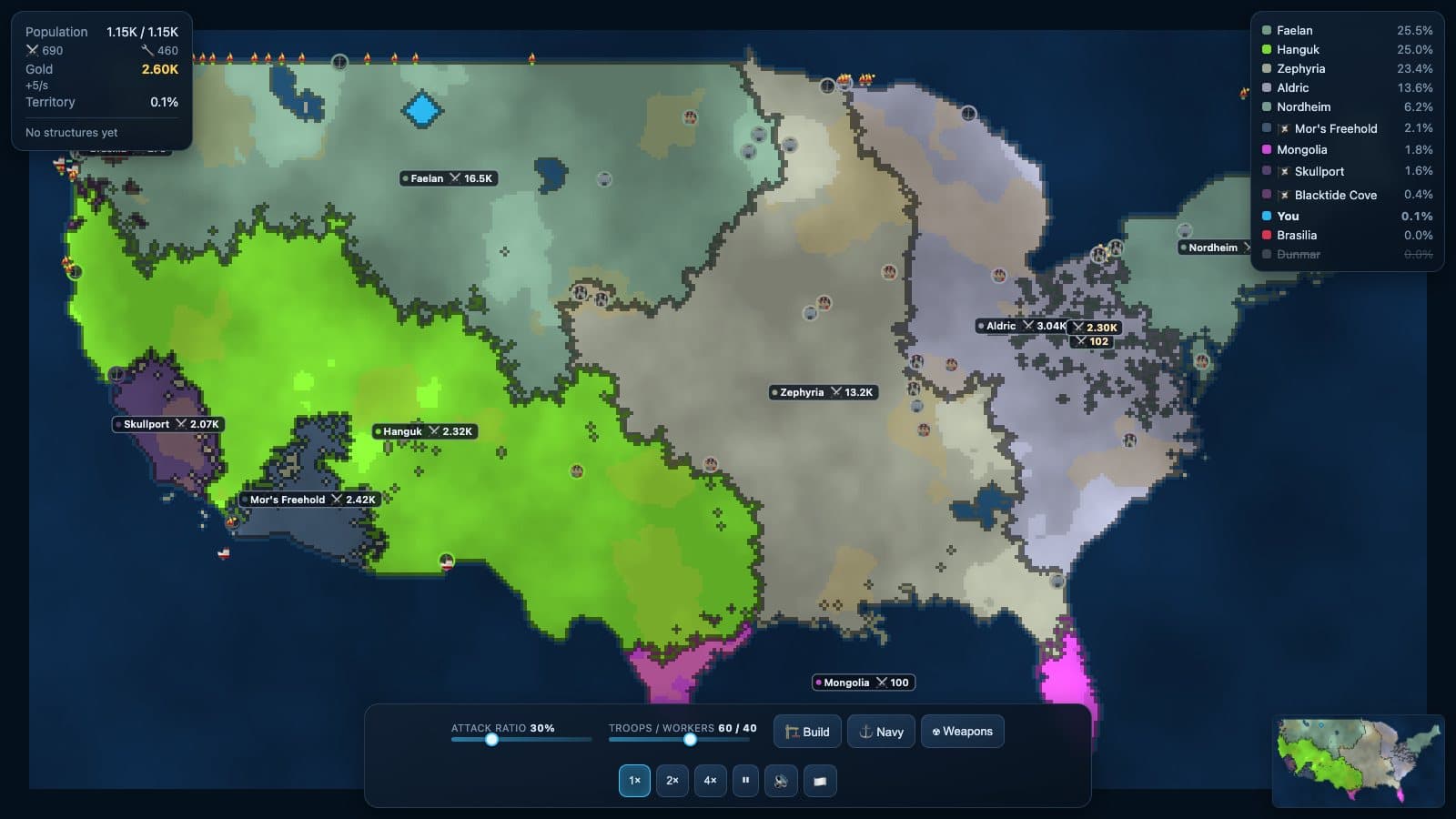
A booster is idle without a city and a factory
The code checks every railway and airport on its own. It looks for a city or capital and a factory owned by you inside the booster's radius, measured as straight-line distance in tiles. If both are there, the booster adds its bonus. If either is missing, it adds nothing.
| Railway | Airport | |
|---|---|---|
| First copy | 3,500 gold | 7,000 gold |
| Boost | +0.04 | +0.07 |
| Radius | 6 tiles | 12 tiles |
| Tiles covered | 113 | 441 |
| Needs in range | city or capital, and a factory | city or capital, and a factory |
The game tells you when you get it wrong. The build log reads "idle! It needs a city AND a factory within range" and names the radius, and the official FAQ has an entry for the same mistake.
The airport's radius is its real selling point. A factory and a city 20 tiles apart cannot share a railway, but one airport placed between them covers both. For a compact cluster the extra radius buys nothing.
Payback depends on your income, so we computed it
We took five nations with full populations and a 40% worker slider, which is what the default 60/40 split gives you (see the troops and workers slider). Base income is the gold per second before any multiplier.
| Nation | Tiles | Cities | Factories | Base income | 1st railway pays back in | 1st airport pays back in | Next factory pays back in |
|---|---|---|---|---|---|---|---|
| Small | 600 | 1 | 1 | 35.4/s | 41.2 min | 47.1 min | 8.3 min |
| Mid | 2,000 | 3 | 2 | 90.6/s | 16.1 min | 18.4 min | 11.1 min |
| Large | 5,000 | 5 | 3 | 163.4/s | 8.9 min | 10.2 min | 13.9 min |
| Huge | 10,000 | 8 | 4 | 273.6/s | 5.3 min | 6.1 min | 19.4 min |
| Huge, 70% workers | 10,000 | 8 | 4 | 451.8/s | 3.2 min | 3.7 min | 19.4 min |
The factory column is the comparison that matters. A factory pays a flat 9 gold per second whatever your size, so its payback only gets slower as the price rises with every copy. A booster's payback gets faster as you grow. They cross somewhere in the middle.
A city is a stronger rival than a factory in the early game, for the reasons in what to build first: it raises the population cap by 3,500, and the extra workers pay for it. Boosters sit behind both on the shopping list.
The growth half of the bonus is small
The multiplier also speeds up population growth, but only while there is room under the cap. We simulated a 2,000-tile nation with 3 cities refilling from 50% to 90% of its cap, including the recruit pulse every 15 seconds.
| Multiplier | Seconds to refill |
|---|---|
| x1.00 | 60.0 |
| x1.04 (one railway) | 59.8 |
| x1.07 (one airport) | 57.3 |
| x1.25 (capital) | 45.0 |
| x1.60 (cap) | 37.6 |
One railway saves a fifth of a second. The growth side of a booster is a rounding error, so judge boosters on gold alone. The capital is the one that changes recovery speed, and at 15,000 gold it is a separate decision.
Each type has its own price curve, so mix them
Prices escalate per copy: the second costs 1.5 times the first, the third 2 times, the fourth 2.5 times, and from the fifth on each copy adds another full base price. Railways and airports are counted separately.
| Copy | Railway, gold per point of boost | Airport, gold per point of boost |
|---|---|---|
| 1 | 875 | 1,000 |
| 2 | 1,313 | 1,500 |
| 3 | 1,750 | 2,000 |
| 4 | 2,188 | 2,500 |
| 5 | 3,063 | 3,500 |
A railway is cheaper per point at every copy. But the third railway (1,750 per point) costs more than the first airport (1,000), so after two railways it is cheaper to switch type. Add up the cheapest order and you get railway, airport, railway, airport, railway, airport, railway: 4 railways and 3 airports for 56,000 gold and a boost of 0.37.
The ceiling is 0.35 with a capital, because 0.25 of the 0.6 cap room is already used. Without one it is 0.6. All railways would need 9 copies and 120,750 gold to reach 0.35, and all airports would need 5 copies and 73,500 gold. The mix beats both.
At 56,000 gold, the full build earns its price back in 9.7 minutes for a 10,000-tile nation, 16.3 for a 5,000-tile one and 29.4 for a 2,000-tile one. On a 45-minute clock that last number is a long wait, so the full build only makes sense for the biggest economies.
Trade income ignores all of this
Trade ships pay gold straight into your treasury, so the multiplier does not touch them. If a port route is your main income, the same 4% is worth less. The numbers in how much gold traders make are unaffected by your boosters.
The AI plays by the same formula. On Normal a bot gets 0.08 added to its multiplier and on Hard 0.30, before it builds a thing, as we covered in the Easy, Normal and Hard breakdown. Boosters are one way for a human to close that gap.
How another game handles the same idea
OpenFront gives rail a different job. In its own translation file the factory is described as "Creates railroads and spawns trains", and the help text says trains "give you a fixed amount of gold for each building they visit along the route". Cities, in the same file, increase your max population. So there the rail is a route that pays per stop, and in Frontlines it is a percentage on everything you already earn. We make Frontlines, not OpenFront, and the OpenFront repository is open if you want to compare the numbers yourself.
Where to place the first one
Put it within 6 tiles of a factory and a city, away from the border. Buildings change hands when their tile is captured (defense posts are the exception and are destroyed instead), so a lost cluster becomes the attacker's income. A defense post covers 8 tiles, which is enough for a whole 6-tile cluster. If you cannot fit them inside 6 tiles, an airport covers the gap for twice the gold.
Open a solo match at playfrontlines.com and watch the income line: the multiplier tag goes up the moment a booster has both its neighbors.
More from the blog.
Frontlines Trade Ships: How Much Gold a Trader Earns
A trader costs 800 gold and earns about 830 gold a minute on a typical 120-tile route. Payback, the port ladder and the catch, replayed from the game code.
Oct 15, 2026 · 6 min
Troops vs Workers in Frontlines: Where to Set the Slider
The slider does not change how fast you expand. It trades gold for defense: 95/5 earned 45% less than 20/80 but survived 39 of 48 matches, not 26.
Oct 11, 2026 · 6 min
What to Build First in Frontlines
A city pays for itself in 3 minutes 25 seconds, a factory in 5 minutes 35. The build order for your first ten minutes, with numbers from the game code.
Oct 03, 2026 · 5 min