What to Build First in Frontlines
A city pays for itself in 3 minutes 25 seconds, a factory in 5 minutes 35. The build order for your first ten minutes, with numbers from the game code.
Build a city first. It is cheaper than a factory, it earns more gold, and it is the only one of the two that also gives you an army.
That is not a hunch. The numbers on this page are read from the game's own configuration file and then run through the same formulas the game uses every tick. Where a number comes from a simulation, the text says what was simulated.
Gold comes from two places
Every nation starts with 800 people and 500 gold. From then on, gold arrives each second from exactly two sources.
Workers earn 0.011 gold per second each. A thousand workers are 11 gold per second.
Factories earn a flat 9 gold per second each, no matter how many people you have.
There is also a one-time 1.2 gold for every tile you conquer, which is why the opening land grab funds your first building.
Your people are one pool, split by the Troops / Workers slider. The default is 60% troops and 40% workers. Troops fight and workers earn. So every source of gold except factories is really a question about population, and population has a ceiling.
The population cap is the number that matters
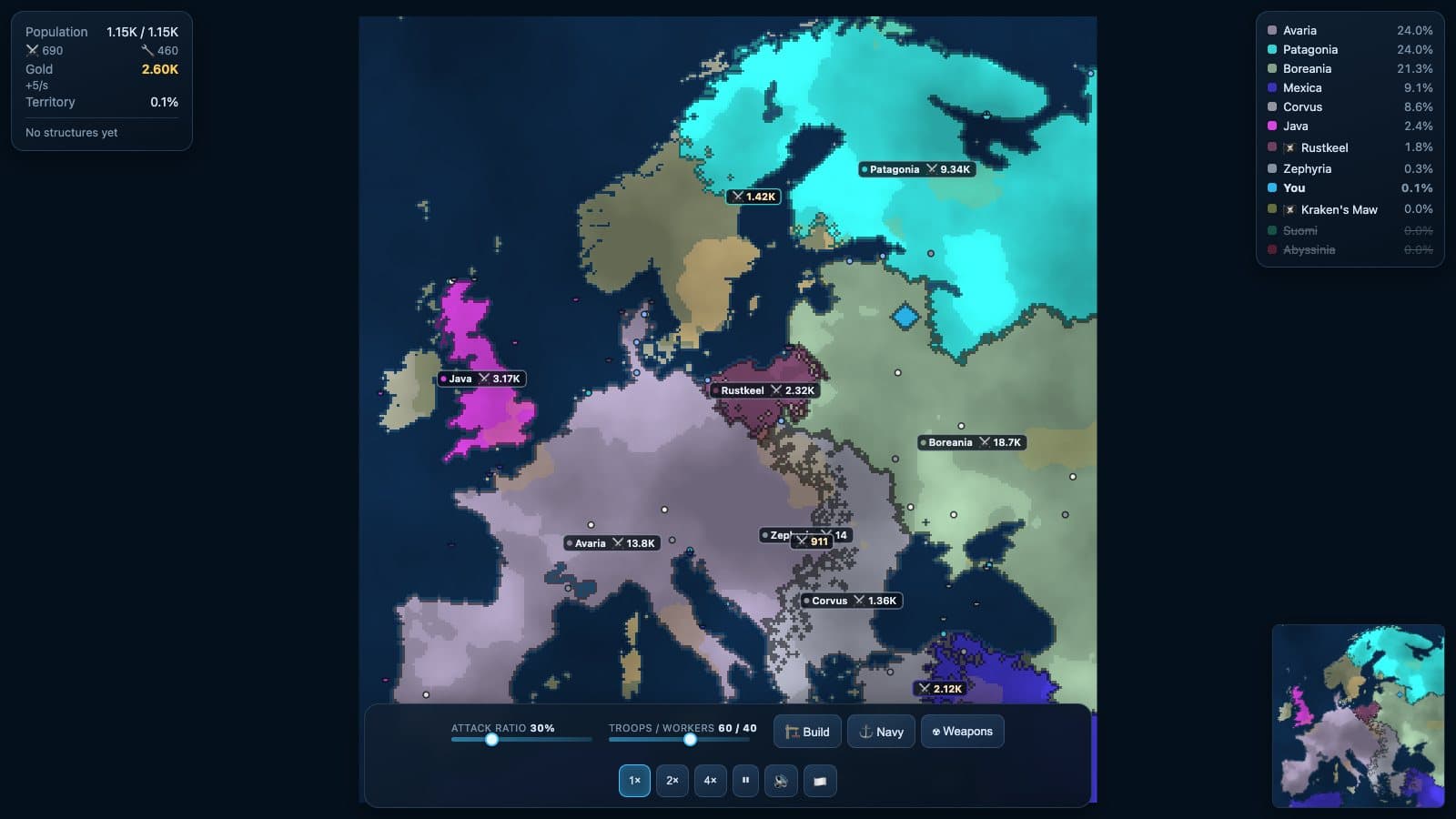
Your cap is 1,000, plus 2.5 for every tile you hold, plus 3,500 for every city, plus 8,000 if you have a capital.
A nation with 600 tiles and no buildings tops out at 2,500 people. At the default slider that is 1,000 workers and 11 gold per second. It will stay at 11 gold per second for the rest of the match unless the cap moves.
Population grows toward the cap along a logistic curve: fast when there is room, slower as it fills, zero at the cap. On top of that, every 15 seconds a recruitment pulse adds 3% of your current population. In practice an empty city fills quickly. In a simulated run, the nation above reached 90% of its new cap 1 minute 4 seconds after the city went up.
A city beats a factory on gold alone
Here is the comparison that settles it. One nation, 600 tiles, population full, slider at 60/40, at peace. It buys either a city or a factory at minute zero, and the economy runs.
| After | Nothing built | Factory first | City first | City's lead, net of price |
|---|---|---|---|---|
| 2 min | 1,320 | 2,400 | 2,581 | +681 |
| 4 min | 2,640 | 4,800 | 5,749 | +1,449 |
| 6 min | 3,960 | 7,200 | 8,917 | +2,217 |
| 8 min | 5,280 | 9,600 | 12,085 | +2,985 |
| 10 min | 6,600 | 12,000 | 15,253 | +3,753 |
The columns are total gold earned since the purchase. The last column subtracts what each building cost.
The city is ahead from the second minute and never gives the lead back. Once its 3,500 extra people have arrived, 40% of them are workers, which is 15.4 gold per second against the factory's 9.
Then there is the part the table does not show. After ten minutes the city nation has 3,600 troops. The factory nation has 1,500. A factory has never defended a border.
Every copy costs more than the last
You cannot simply build six cities, because the price climbs with each copy you own.
| Copy | City | Factory | Port | Defense post |
|---|---|---|---|---|
| 1 | 2,500 | 3,000 | 2,500 | 3,000 |
| 2 | 3,750 | 4,500 | 3,750 | 4,200 |
| 3 | 5,000 | 6,000 | 5,000 | 5,400 |
| 4 | 6,250 | 7,500 | 6,250 | 6,600 |
| 5 | 8,750 | 10,500 | 8,750 | 7,800 |
| 6 | 11,250 | 13,500 | 11,250 | 9,000 |
Cities, factories and ports cost 50% more per copy for the first three copies, then 100% more per copy. Defense posts climb by a steady 40%.
The escalation is deliberate. The note next to it in the game code says the Nth city should be a commitment, not a spam click. It works: the fifth city costs three and a half times the first, and at some point the cheapest way to raise your cap is to take land instead.
That point comes sooner than you might expect. A fifth city costs 8,750 gold for 3,500 people. The same 3,500 people come from 1,400 tiles, and tiles also pay 1.2 gold each when you take them.
Factories have a deadline
A factory's 9 gold per second never changes, so its payback time is simple division.
| Factory | Cost | Pays for itself after |
|---|---|---|
| 1 | 3,000 | 5 min 33 s |
| 2 | 4,500 | 8 min 20 s |
| 3 | 6,000 | 11 min 07 s |
| 4 | 7,500 | 13 min 53 s |
| 5 | 10,500 | 19 min 27 s |
Now put that next to the clock. A match ends when someone holds 70% of the land, and if nobody does, the biggest nation wins after 45 game minutes on a Normal world. On Large it is 67.5 minutes and on Huge it is 90.
A fourth factory bought at minute 32 of a Normal match will not earn back its price before the game is over. Late gold belongs in troops, ships or a missile.
So why build factories at all? Two reasons. Their income does not depend on population, so it keeps flowing while a war is draining your people. And a railway or an airport only pays its growth and gold bonus when a city and a factory both sit inside its radius, so one factory near your cities is the key to those boosts.
— Rule of thumbCities until the next one costs more than a war would. One factory for the day the war comes.
A build order for the first ten minutes
This is the opening the numbers point to, with the reasoning behind each step.
- Take free land first. A neutral tile costs about one troop, more on mountains and desert, and pays 1.2 gold. The land grab raises your cap and pays for the first city.
- First city at 2,500 gold. Nothing else you can buy returns its price in under three and a half minutes.
- Second city at 3,750. Still better value than a first factory, and it adds another 2,100 troops at the default slider.
- Then choose by your border. Peaceful neighbors: a third city at 5,000. A nation leaning on you: a factory at 3,000, because that income survives the fight, or a defense post at 3,000, which makes every tile within 8 tiles of it cost 60% more troops to take.
- A port once you touch the sea. It costs 2,500 and nothing naval exists without one. Each port lets you run 2 traders, 2 warships, 3 transports and 1 carrier.
- The capital is a mid-game purchase. 15,000 gold buys 8,000 population cap and 25% more growth and gold. If you lose it, your defense drops by 20% for 30 seconds, so build it away from the front.
If you have played territorial.io or OpenFront, the map-painting half of this will feel familiar. The buying decisions are where Frontlines asks more of you, and they are also where most first matches are lost. You can try the opening above right now: Frontlines is free in the browser, and the FAQ covers the controls.
If you like having the numbers before you commit, the same treatment exists for our turn-based game in RISK dice odds, every attack calculated.
More from the blog.
Frontlines Trade Ships: How Much Gold a Trader Earns
A trader costs 800 gold and earns about 830 gold a minute on a typical 120-tile route. Payback, the port ladder and the catch, replayed from the game code.
Oct 15, 2026 · 6 min
Troops vs Workers in Frontlines: Where to Set the Slider
The slider does not change how fast you expand. It trades gold for defense: 95/5 earned 45% less than 20/80 but survived 39 of 48 matches, not 26.
Oct 11, 2026 · 6 min
How Alliances Work in Frontlines, and What Betrayal Costs
A solo alliance lasts 10 minutes. Leaving gives a 5-minute truce, betraying makes you 35% easier to conquer for good. Every number from the game code.
Oct 13, 2026 · 5 min