First-Player Advantage in RISK-Style Games, Measured
Seat 1 wins 74% of two-player CONQUEST games between equal bots, 92% with a manual draft. With 3 to 6 players on the World map, order barely matters.
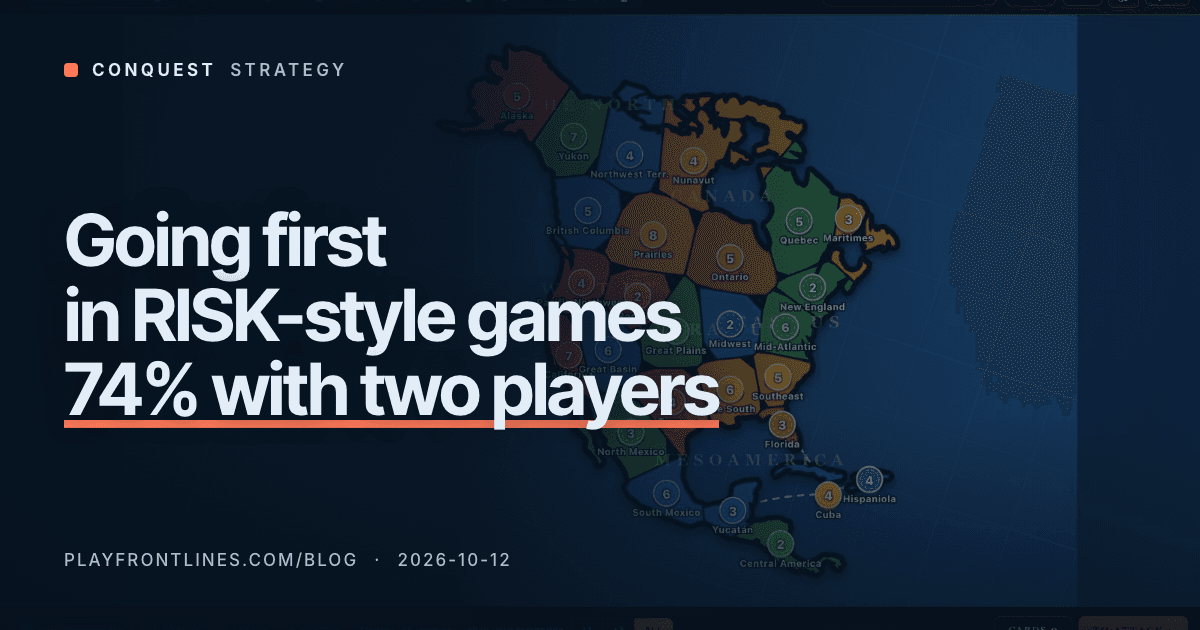
With two players, moving first matters a lot. Seat 1 won 74.1% of 1,000 two-player World map games between equal Hard bots in CONQUEST, and 92.4% when the territories were picked by manual draft.
With three to six players on the World map, the seats ended up within about 3 points of a fair share. On the small 18-territory maps the last seat is the strong one.
CONQUEST is a RISK-style game and is not affiliated with Hasbro, the maker of RISK. The numbers below describe CONQUEST's rules and its bots, not the board game.
Seat 1 wins about 74% of two-player games
The old claim is that the first attacker in a two-player RISK game "has an enormous advantage". This one is from a 2007 post on the Total Diplomacy Risk forum, and it comes without numbers. We put numbers on it for CONQUEST.
Method: the real rules engine and the real bot brains from the game, every seat the same difficulty, 1,000 games per row, so the only difference between the seats is turn order. Wild dice and auto-deal unless a row says otherwise. The script is scripts/research/conquest-turn-order.mjs in the blog repository.
| Two players | Seat 1 wins | Seat 2 wins |
|---|---|---|
| World, Easy bots | 69.6% | 30.4% |
| World, Medium bots | 73.8% | 26.2% |
| World, Hard bots | 74.1% | 25.9% |
| World, God bots | 72.1% | 27.9% |
| World, Hard, Capitals mode | 71.4% | 28.6% |
| Europe, Hard | 69.5% | 30.5% |
| USA, Hard | 70.8% | 29.2% |
| Africa, Hard | 68.0% | 32.0% |
| Japan, Hard | 67.6% | 32.4% |
| British Isles, Hard | 63.1% | 36.9% |
Every row points the same way. Bot level barely moves it, and the smallest map has the smallest gap.
What the engine fixes is the order of events. Turn 1 belongs to seat 1: it collects its reinforcements and attacks before the other player has placed a single army. With 40 starting armies spread over 21 territories, the board it attacks into averages about 1.9 armies per territory.
After seat 1's first turn on the World map, it held 25.3 of the 42 territories on average and seat 2 held 16.7. By the end of round 1, with seat 2 having answered, they were level at 20.8 and 21.2. Seat 1 still goes on to win 74% of the games, so the lead is not sitting in the territory count. We did not break down where it sits.
A manual draft makes the first strike worth even more
In a manual draft both players claim territories one at a time, then place the remaining starting armies three at a time. Seat 1 claims first. You would expect that to pay for seat 1, and the numbers say the opposite on paper.
At the end of 1,000 drafts between Hard bots, seat 2 held more of the board's value. Seat 1 owned 2.0 whole regions on average and seat 2 owned 3.0. Seat 2 had more first-turn armies in 99.3% of drafts: 19.0 against 16.9.
Seat 1 still won 92.4% of those games. It moves first, so it strikes before seat 2 has spent any of that income. After seat 1's first turn it held 30.7 territories to 11.3, and after round 1 it was still ahead, 24.9 to 17.1.
With three or more players on the World map, order washes out
Add a third player and the effect disappears. Each bot now has two opponents, and the first mover's early strike is only one of several things that happen before its next turn.
| World, Hard bots | Seat 1 | Seat 2 | Seat 3 | Seat 4 | Seat 5 | Seat 6 |
|---|---|---|---|---|---|---|
| 3 players (fair 33.3%) | 32.4% | 34.4% | 33.3% | |||
| 4 players (fair 25.0%) | 25.7% | 26.0% | 27.0% | 21.4% | ||
| 5 players (fair 20.0%) | 19.2% | 21.7% | 20.2% | 18.5% | 20.3% | |
| 6 players (fair 16.7%) | 18.2% | 15.4% | 13.6% | 16.6% | 18.1% | 17.9% |
With 1,000 games a row, a seat's share carries a standard error of roughly 1.2 to 1.6 points, so gaps under about 3 points are noise. A few cells sit just outside that band, but no seat does it in a consistent direction, and the 4-player Medium and God bot rows land between 23.6% and 26.8%.
Easy bots are the exception. In a 4-player World game the seats won 15.0%, 21.5%, 26.7% and 36.8%, a clean climb toward the last seat. Easy bots start out needing about 2.2 times the defender's armies before they attack and make at most two attacks a turn, with the bar sliding down as the game drags on (the PROFILES table and botStep in bots.js). We did not isolate why that makes late seats stronger.
On small maps the last seat is the strong one
The picture changes on the four 18-territory maps. In 4-player games between Hard bots, the last seat won a third or more of the games:
| 4 players, Hard bots | Seat 1 | Seat 2 | Seat 3 | Seat 4 |
|---|---|---|---|---|
| South America (18 territories) | 19.1% | 22.3% | 20.7% | 37.8% |
| Germany (18) | 19.0% | 21.4% | 23.6% | 36.0% |
| British Isles (18) | 21.1% | 22.8% | 21.9% | 34.1% |
| Nordics (18) | 22.8% | 22.6% | 22.0% | 32.6% |
| Oceania (19) | 22.6% | 21.6% | 26.7% | 29.1% |
| Europe (27) | 24.0% | 22.8% | 25.3% | 27.8% |
| USA (39) | 26.0% | 26.3% | 22.5% | 25.2% |
The same shape shows up on British Isles with other table sizes: the last seat won 37.8% of 3-player games and 27.6% of 5-player games. The effect fades as the map grows. At 27 territories and above the last seat's lead is within a couple of points of noise.
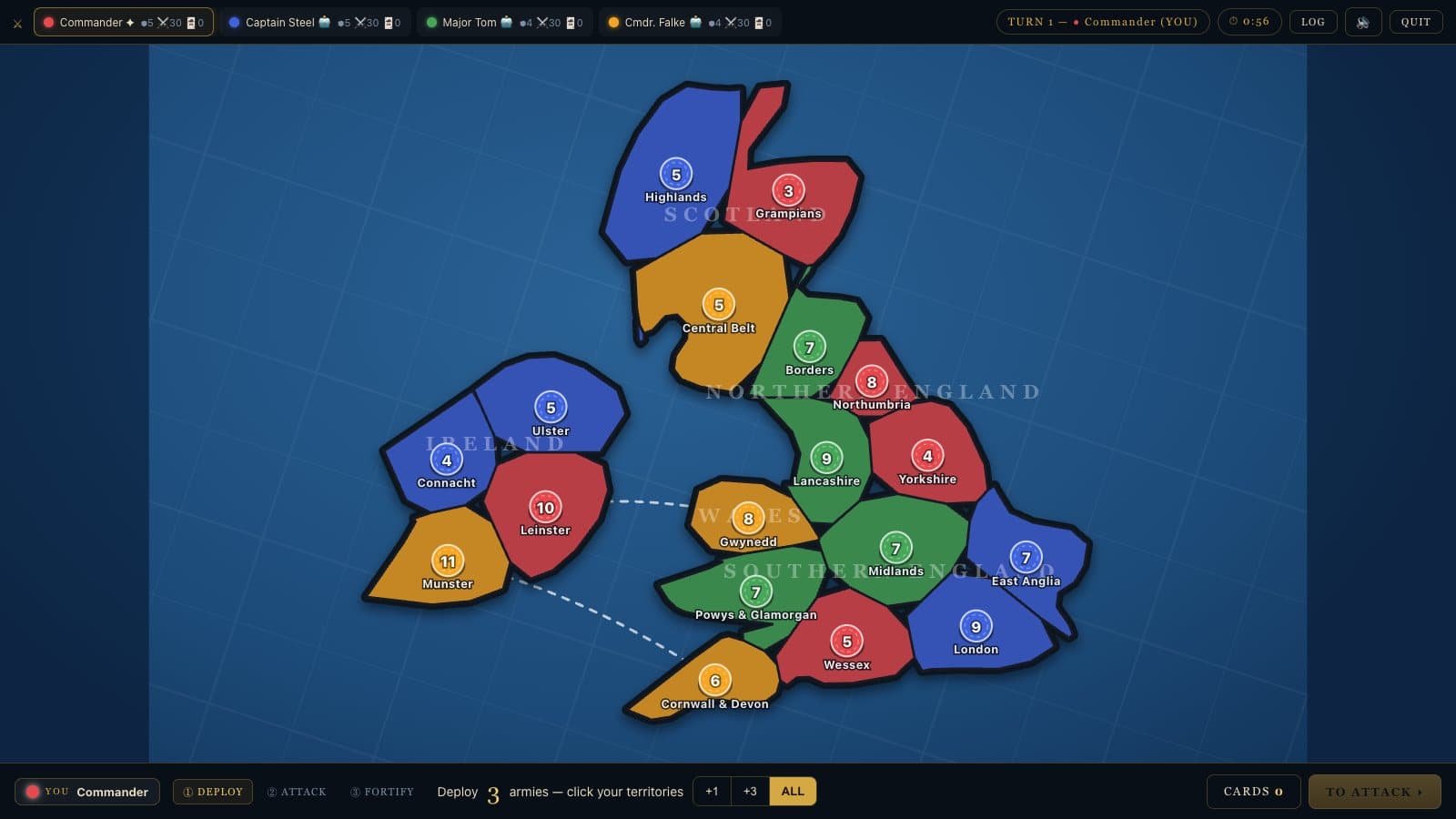
We have the pattern but not the mechanism, so treat the small-map result as a measured tendency, not a rule you can lean on.
Seat 1 is whoever created the lobby
The server builds the seats from the lobby list in order, and the list is never shuffled (startGame in server/index.js). The player who created the lobby sits first and moves first. Seat colors are handed out the same way, and the first color in the palette is a red.
A player who joins later is added to the end of the list. If the lobby is full of bots, a joining human replaces the first bot and still lands last. The host can kick players, add bots and start the game, and there is no control for reordering seats.
Quick Play creates a lobby with you in it and fills the empty seats with bots, so against bots you are always seat 1.
The board game handles this differently. The Hasbro rulebook (the 2010 edition) says players roll a die to see who goes first, and its two-player rules add three neutral armies that sit on the board as roadblocks. CONQUEST has no die roll and no neutral army: all 42 World territories are split 21 and 21, so neither side has a buffer of neutral territories to soak up the first strike. We did not test a neutral-army variant.
What to do with this at your table
- Two players, anything beyond a casual game: play games in pairs and swap who hosts. Seat 1 won roughly two games in three on every map we tested.
- Manual draft with two players: the draft cannot compensate for moving second, so treat it as a source of income you must defend, not a way to catch up.
- Three to six players on the World map: do not argue about seat order. The numbers do not show an effect worth arguing about.
- Small maps with three to five players: the last seat tested strongest in bot games, so the host, who always sits first, holds a seat in the weaker part of the table.
- Against bots in Quick Play: you move first. See the dice odds for how to spend that first turn's attacks and the card values for what the first conquest is worth.
For setting up a table of friends, the room setup guide covers seats, turn timers and what the host controls. For the first-claim question in a manual draft on the World map, which continent to take first has the region numbers. To test it yourself, create a 2-player lobby in CONQUEST, choose Manual draft or Auto-deal (both are explained on the how to play page) and see what your first turn does to the board.
More from the blog.
RISK-Style Browser Games: Which Need No Account?
Five RISK-style games you can play online, checked on their own sites: who asks for an account, who has bots, and how long a 2-player game runs.
Oct 18, 2026 · 5 min
CONQUEST Capitals Mode: 4 Players Finish in 9 Rounds
Capitals mode ended 4-player World games in 9 rounds instead of 32. How the capital is picked, why it starts exposed, and how to play for it.
Oct 16, 2026 · 6 min
CONQUEST Bots: What Easy, Hard and God Mode Really Do
Easy bots won 5% of mixed games, Hard and God Mode 36% each. What each CONQUEST bot level attacks with, when it gives up, and how to beat it.
Oct 14, 2026 · 6 min