RISK Cards: When to Trade In Sets, With the Numbers
A card set pays 4 armies first and 60 by the 15th trade. Exact CONQUEST card values, the 5-card rule and when to cash in, computed from the game's rules.
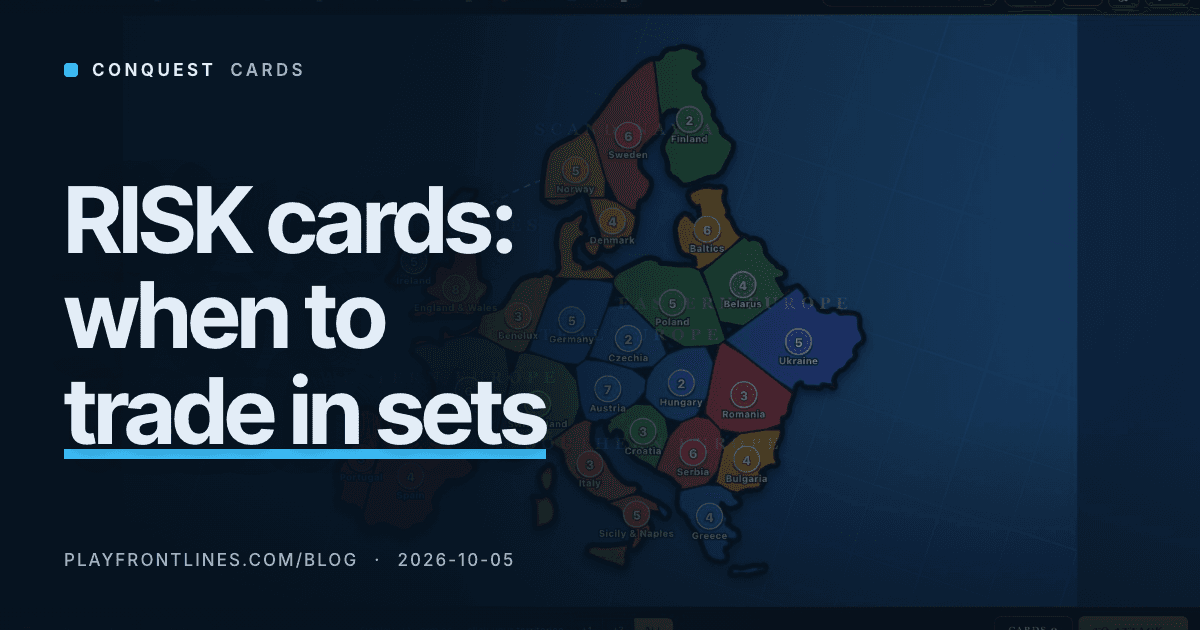
Trade a set the turn you can, unless you play with fixed cards and are one card short of a one-of-each set. The first set in a game pays 4 armies, the sixth pays 15 and the fifteenth pays 60.
Those values belong to the whole table, not to you. Every set that anyone trades pushes the next one up.
Everything below was read from the rules code of CONQUEST, our RISK-style browser game, and the hand odds were computed by script. CONQUEST is not affiliated with Hasbro, the maker of RISK, but it follows the board game's card rules closely, and where it differs we say so.
The first set pays 4 armies and the fifteenth pays 60
In progressive mode, the default, the value of a set depends only on how many sets have been traded so far in the match. The code comment in the engine reads "escalating trade values: 4,6,8,10,12,15,... capped at 60".
| Set traded in the game | Armies | Running total |
|---|---|---|
| 1st | 4 | 4 |
| 2nd | 6 | 10 |
| 3rd | 8 | 18 |
| 4th | 10 | 28 |
| 5th | 12 | 40 |
| 6th | 15 | 55 |
| 7th | 20 | 75 |
| 8th | 25 | 100 |
| 10th | 35 | 165 |
| 12th | 45 | 250 |
| 15th | 60 | 415 |
| 16th and later | 60 | 475 and up |
The jump from 12 to 15 to 20 is where games turn. After the sixth set each one adds a flat 5 armies, which matches the official RISK rules from Hasbro: "After the sixth set has been traded in, each additional set is worth 5 more armies." The cap at 60 is CONQUEST's own. The printed rules have no ceiling.
One counter serves the whole table
— Hasbro RISK rules, 'Trading In Cards for Armies'Take additional armies based on the total number of sets anyone has traded in so far.
CONQUEST keeps a single counter for the match, not one per player. In the engine it is a field called setsTraded on the game state, raised by every trade from every seat.
This changes what a 4-player game looks like. If each player cashes in once, the fifth set already pays 12 armies, three times what the opener got. A player who traded first got the smallest check of the match. A player who sat on a set and traded fifth got the biggest of those five.
That sounds like a reason to wait. It is a weaker reason than it looks, for three reasons:
- You are betting that someone else trades first, and a quiet table means you gain nothing for waiting.
- The armies you skip are armies you do not have for this turn's attacks, and you need conquests to earn the next card.
- Cards are cargo. Eliminate a player and you take their hand, so the player who holds a set is carrying armies for whoever finishes them off.
A set is worth more than a whole turn of income
The base income in CONQUEST is your territory count divided by 3, rounded down, with a minimum of 3. Region bonuses come on top. The script prints the base values.
| Territories you own | Base armies per turn |
|---|---|
| 6 or 9 | 3 |
| 12 | 4 |
| 15 | 5 |
| 18 | 6 |
| 21 | 7 |
| 24 | 8 |
| 30 | 10 |
A first set of 4 doubles the income of a player on 12 territories. A sixth set of 15 pays out more than twice the income of a player on 21. By the middle of a match sets also outgrow region bonuses: on the World map the largest region bonus is 7 for Asia, and the 8th trade alone pays 25.
Five cards always contain a set
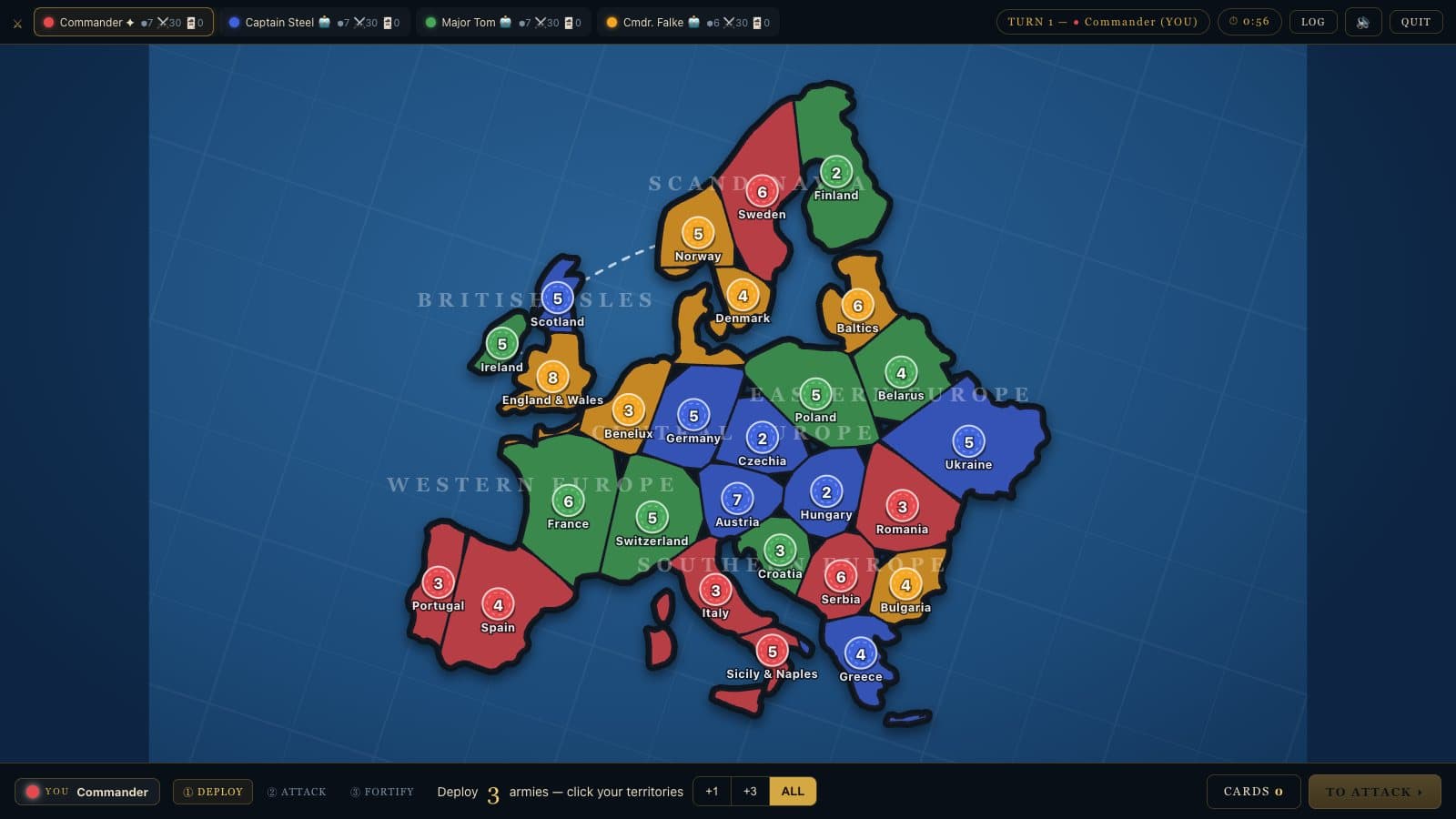
The engine builds the deck the way the board game does: one card per territory plus 2 wilds, as the Wikipedia entry on RISK describes for the physical deck of 42 territory cards and two wilds. Territory cards are assigned in turn as infantry, cavalry and artillery, so each type holds about a third of the territories. A valid set is three of one type, one of each type, or any two cards plus a wild.
We listed every possible hand of 3, 4 and 5 cards by type count, weighted by the exact chance of drawing it, and checked each one against the engine's own set check.
| Map (territories) | 3 cards | 4 cards | 5 cards |
|---|---|---|---|
| World (42) | 42.3% | 81.7% | 100.0% |
| USA (39) | 42.9% | 82.0% | 100.0% |
| Europe (27) | 46.8% | 83.6% | 100.0% |
| Germany (18) | 52.6% | 86.1% | 100.0% |
The 100% in the last column is not luck. With five cards and three types, either one type shows up three times, or the types split 2, 2, 1 and all three are present. A wild finishes any pair. So a hand of five can never be stuck, which is why the forced trade at 5 cards is safe to design around.
It also tells you how long hoarding can last. You earn at most one card per turn, and only on a turn where you captured a territory. A hand of four is already a set more than eight times in ten, so waiting for a perfect combination mostly means waiting for the forced trade.
Fixed mode is the only place waiting pays
In fixed mode each kind of set has its own price, and the engine picks the best use of a wild.
| Set | Armies |
|---|---|
| Three infantry | 4 |
| Three cavalry | 6 |
| Three artillery | 8 |
| One of each | 10 |
| Wild plus any two | the best of the above |
Nothing escalates, so there is no shared counter to watch. The question is only what you hold. If you have three infantry and a cavalry, a 4-army trade is available now and a 10-army trade is one artillery away. Holding costs a turn of armies and a card slot, and the forced trade at 5 cards caps how long the wait can last. Only wait when the missing card would lift the trade from 4 to 10.
The setup screen is where you pick progressive or fixed. The room setup guide lists every option the host controls.
Two details differ from the board game
CONQUEST adds the +2 territory bonus once per trade. If a traded card shows a territory you own, that territory gets 2 extra armies on the spot, on top of the set value. The Hasbro rules cap that extra at 2 armies per turn, while the CONQUEST engine applies it on every trade. When you hold two sets, the second trade can carry its own bonus.
The other difference is the forced trade. The printed rules say that with 5 or 6 cards you must trade at least one set. CONQUEST keeps trading you down until you hold fewer than 5. The result is the same hand sizes, with no way to leave a fifth card sitting there.
Cards also reward the kind of attack the odds support. You earn a card only if you capture something, so one safe capture at the end of a turn beats a long gamble. The exact numbers on which attacks are safe are in RISK dice odds, every attack calculated. The CONQUEST rules page lists the card rules in a few lines if you want them next to the board.
The bots trade on a fixed schedule
The bot code gives each difficulty a flag called eagerTrade. Medium, Hard and God Mode trade the moment they hold a set. Easy waits until it holds 5 cards or the next set would pay at least 10 armies.
Against bots, that tells you what an Easy opponent is sitting on: a set it will not cash in until the payout is large or it holds 5 cards. Capture its last territory and the hand is yours. If you want a real-time game with no cards at all, the economy in what to build first in Frontlines is the same kind of exercise for our other game. For a wider look at what else you can play, see the alternatives page, where RISK: Global Domination, Warzone and others sit next to us.
The rules come from shared/engine.js and shared/bots.js in the CONQUEST code. The values and hand odds can be regenerated with scripts/research/conquest-cards.mjs in the blog repository.
More from the blog.
RISK-Style Browser Games: Which Need No Account?
Five RISK-style games you can play online, checked on their own sites: who asks for an account, who has bots, and how long a 2-player game runs.
Oct 18, 2026 · 5 min
CONQUEST Capitals Mode: 4 Players Finish in 9 Rounds
Capitals mode ended 4-player World games in 9 rounds instead of 32. How the capital is picked, why it starts exposed, and how to play for it.
Oct 16, 2026 · 6 min
CONQUEST Bots: What Easy, Hard and God Mode Really Do
Easy bots won 5% of mixed games, Hard and God Mode 36% each. What each CONQUEST bot level attacks with, when it gives up, and how to beat it.
Oct 14, 2026 · 6 min