Which Continent to Take First in CONQUEST (World Map)
Oceania and South America each pay 2 armies a turn for about 9 expected losses. Oceania has one door. All six regions of the World map, computed.
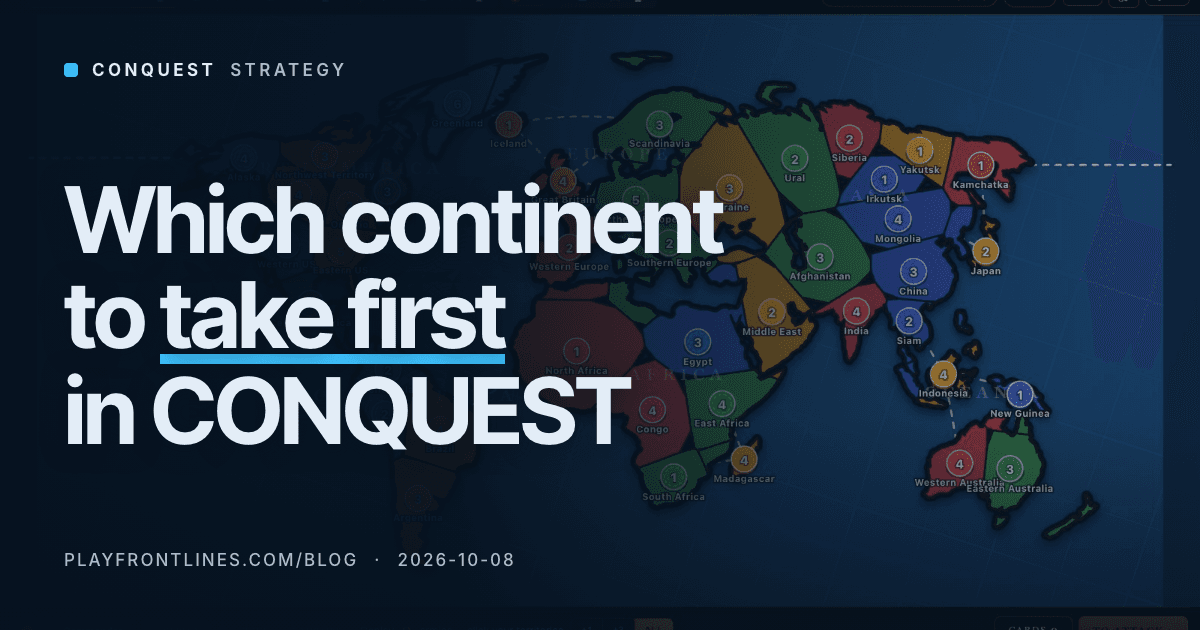
Take Oceania first. If the deal does not give you most of it, take South America. Both regions have four territories and pay 2 extra armies a turn, and clearing either one at 3 defenders per territory costs about 9.2 armies in expected losses. Oceania has one territory that touches the outside world. South America has two.
That is the answer for the World Classic map in CONQUEST. North America is the sensible second step. Europe, Africa and Asia come later, once you own enough armies to hold them. The numbers below come from the game's own map data and rules, not from board-game folklore.
Six regions, one table
We read the World Classic map (42 territories, six regions) and the reinforcement rule straight from the game code, then computed the rest with a script. Reinforcements each turn are your territories divided by 3, rounded down, minimum 3, plus the bonus of every region you own completely.
| Region | Territories | Bonus | Territories to guard | Enemy tiles that touch it | Expected losses to clear | Turns to repay |
|---|---|---|---|---|---|---|
| Oceania | 4 | 2 | 1 | 1 | 9.2 | 4.6 |
| South America | 4 | 2 | 2 | 2 | 9.2 | 4.6 |
| North America | 9 | 5 | 3 | 3 | 20.8 | 4.2 |
| Africa | 6 | 3 | 3 | 5 | 13.8 | 4.6 |
| Europe | 7 | 5 | 4 | 6 | 16.1 | 3.2 |
| Asia | 12 | 7 | 5 | 5 | 27.7 | 4.0 |
How the columns were derived:
- Territories to guard are the region's own territories that touch an enemy-held territory outside the region. They come from the map's adjacency: exact shared land borders plus the sea links the map authors drew.
- Expected losses to clear assume 3 armies on every territory and an attacker with a deep stack rolling three dice per round against up to two. Ties go to the defender. We solved it exactly by dynamic programming. One territory with 3 defenders costs 2.31 armies on average, so a four-territory region costs 9.2.
- Turns to repay is the expected losses divided by the bonus. It counts only what the conquest costs, not what holding it costs.
These are Wild Dice numbers. Tactical Dice gives bigger stacks better odds, and the dice odds post has both tables.
The starting garrison is not always 3. With the default setup it runs from 1.90 armies per territory in a 2-player game to 2.98 in a 5-player game, so 3 is a fair round number for the first few turns.
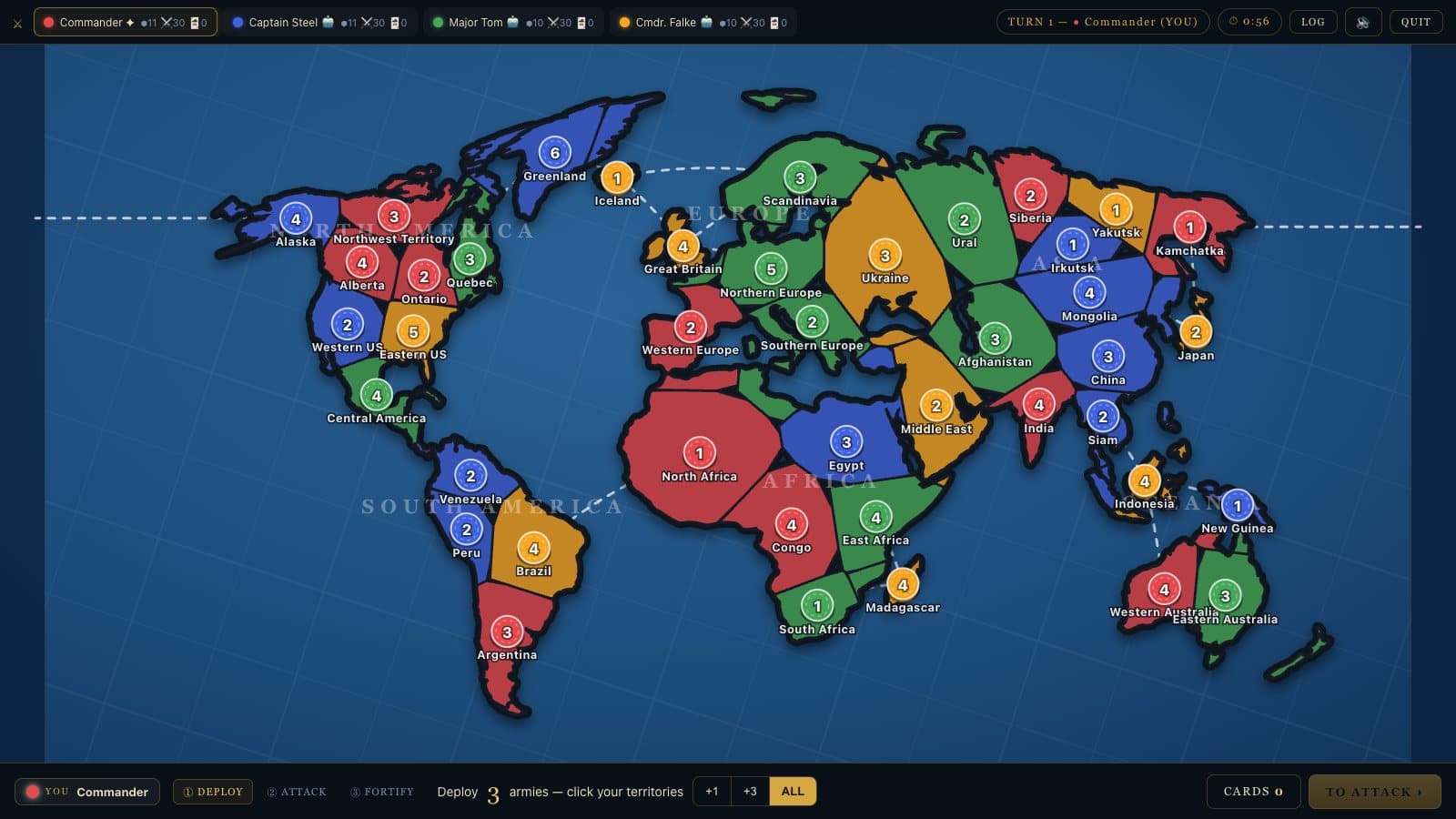
Oceania has one door
Oceania has four territories: Indonesia, New Guinea, Western Australia and Eastern Australia. Only Indonesia touches anything outside, and the only outside tile it touches is Siam. Hold Indonesia with a real stack and the other three need almost nothing.
That makes the bonus close to free. A player who owns only Oceania collects 5 armies a turn instead of 3, which is 67% more income for one defended territory. The board-game community has said the same for a long time. A long-running RISK FAQ says "Australia is often thought to be the best continent, since it's easy to hold (only one border)." CONQUEST is not affiliated with Hasbro, but its World map keeps the classic six-region layout, and the guard counts in the table match the access-point counts on the Wikipedia RISK page.
The price of one door is one target. Everyone can see the bonus and everyone knows where to hit. A stack on Indonesia is what keeps the 2 armies a turn, so do not spend it elsewhere.
South America costs the same and has two doors
South America clears at the same 9.2 expected losses and pays the same 2. Its two exposed territories are Venezuela, which touches Central America, and Brazil, which touches North Africa. You split your defense in two, and one of the two neighbors is a 9-territory region that can feed an attacker for several turns.
What you get for that extra door is reach. Brazil sits across the sea from Africa and Venezuela leads into North America, so South America is a better launch pad than Oceania, which can only go out through Siam into Asia. If the deal gave you three of the four tiles, take South America. If it gave you three of Oceania, take Oceania.
You will almost never be handed a whole region. We simulated 20,000 auto-deals for each player count. At 4 players one player starts with all of Oceania in 0.88% of deals and all of South America in 0.92%. At 6 players it is 0.16% and 0.18%. At 2 players it is about 10%. Plan to take the last tiles yourself.
North America is the second continent
North America has nine territories and a bonus of 5, and it has only three to guard: Alaska, Greenland and Central America. Clearing it at 3 per territory costs 20.8 armies, which repays in 4.2 turns. That is a good rate, but 20.8 armies is a lot to spend before you have any income.
The order that works on paper is small region first, then North America. The 2 or 3 extra armies a turn from the small region pay for the stack that clears the big one. A player holding only North America collects 8 a turn, and one holding North America and Oceania (13 territories) collects 11.
For card timing once the income is flowing, see when to trade in RISK-style cards.
Europe pays back fastest and is the hardest to keep
On paper Europe is the best deal: 5 armies for 16.1 expected losses, repaid in 3.2 turns. The table also shows the catch. Four territories to guard, six enemy tiles touching it, and eight separate routes across its border in the map's link list. Every one of those is a direction an attack can come from.
Africa has the same problem in a smaller package. Only 3 of its tiles are exposed, but they touch five outside tiles across seven routes, and the bonus is 3. Asia pays the most at 7 and has five territories to guard. The same FAQ is blunt about it: "Don't try to take and hold Asia from the start!"
These three are what you take when you have a stack that no neighbor can break. A bonus you cannot hold is worth less than the table says, because the attacker who breaks it also takes the reinforcements.
In a manual draft, the first claim decides it
CONQUEST has an auto-deal and a manual draft. In the draft, players claim one free territory at a time until the map is full, then place their starting armies three at a time. That is where you choose the continent instead of receiving it.
Claim Indonesia first if you want Oceania. It is the one tile that touches the outside, and an enemy sitting on it is inside your region and one step from your other three territories. Then take the remaining three before anyone else asks what you are doing.
The bots also read the board. In the draft code, a Medium, Hard or God bot scores a free tile as 2.2 for each tile it already holds in that region, minus 0.8 for each tile an opponent holds there, plus a quarter of the region bonus, plus a little randomness. Easy bots skip the planning entirely. Opening in a region does not stop the smarter bots from claiming there, but it tilts them away. The same file comments that a bot plans for the region with the "highest bonus-per-missing-territory", so the region you are two tiles short of is the one a Medium or better bot is also looking at.
Playing with people instead of bots? The friends setup guide covers the room options, and the real-time versus turn-based comparison covers whether this game is the right one for your group. The full rules are on the how to play page.
This post covers the World map only. The other 14 maps have their own regions and their own bonuses, so the table above does not carry over.
More from the blog.
RISK-Style Browser Games: Which Need No Account?
Five RISK-style games you can play online, checked on their own sites: who asks for an account, who has bots, and how long a 2-player game runs.
Oct 18, 2026 · 5 min
CONQUEST Capitals Mode: 4 Players Finish in 9 Rounds
Capitals mode ended 4-player World games in 9 rounds instead of 32. How the capital is picked, why it starts exposed, and how to play for it.
Oct 16, 2026 · 6 min
CONQUEST Bots: What Easy, Hard and God Mode Really Do
Easy bots won 5% of mixed games, Hard and God Mode 36% each. What each CONQUEST bot level attacks with, when it gives up, and how to beat it.
Oct 14, 2026 · 6 min