Warship or Carrier in Frontlines: Which Is Worth It
A carrier costs 12,000 gold, a warship 2,500. We ran the duels: 3 warships beat 1 carrier, but only a carrier takes 2 coast tiles a second.
Buy warships first. They cost 2,500 gold, they are the cheapest hit points in the navy, and three of them beat a 12,000-gold carrier.
A carrier earns its price only if you want to take enemy coast without sending a single troop. It does that, slowly, and nothing else in the game does it at all.
Everything below is read from the game code and replayed in a script on the real game engine, so the numbers are what a match does.
The four ships side by side
Every ship is bought from a port, with the keys W (warship), C (carrier), T (transport) and R (trader). Damage in the code is per tick and a tick is a tenth of a second, so we convert to seconds below.
| Ship | Gold | Hit points | Damage per second | Speed (tiles/s) | Limit per port | Gold per hit point |
|---|---|---|---|---|---|---|
| Transport | 1,000 | 28 | none | 6.0 | 3 | 35.7 |
| Trader | 800 | 20 | none | 5.0 | 2 | 40.0 |
| Warship | 2,500 | 100 | 40 | 6.5 | 2 | 25.0 |
| Carrier | 12,000 | 260 | 70 | 3.5 | 1 | 46.2 |
Two things in that table decide most fights. The carrier is nearly twice as slow, so it cannot chase a warship that does not want to fight it. And the carrier's hit points cost almost twice as much gold as a warship's.
One carrier beats two warships, and loses to three
We put ships 2 tiles apart on open sea in the game engine and let navalCombat run until one side was gone. The AI was frozen so nothing else interfered.
| Matchup | Winner | Seconds | Left standing |
|---|---|---|---|
| Carrier vs 1 warship | carrier | 1.6 | carrier with 204 of 260 |
| Carrier vs 2 warships (5,000 gold) | carrier | 3.2 | carrier with 84 |
| 2 warships vs carrier, warships shoot first | carrier | 3.2 | carrier with 68 |
| Carrier vs 3 warships (7,500 gold) | warships | 2.6 | warships with 100 and 30 |
| Carrier vs 4 warships (10,000 gold) | warships | 1.8 | 3 warships, 286 hit points total |
| Carrier vs 5 warships | warships | 1.4 | 5 warships, one with 2 hit points |
| 2 warships vs 2 warships | first shooter | 2.6 | both survivors at 4 hit points |
The paper math agrees. A carrier sinks a warship in 1.4 seconds (100 hit points at 70 per second). A warship needs 6.5 seconds to sink a carrier (260 at 40). Add warships and their combined damage shrinks the carrier's clock faster than it can empty theirs.
The last row is a warning about coin flips. Equal fleets are decided by who happens to shoot first in the update order, and the survivors are almost dead. A navy that is only equal is not a navy you want to meet.
The limits are per port and per kind
A port supports its own flotilla: 3 transports, 2 traders, 2 warships and 1 carrier. The four limits do not share slots. One port means 2 warships and a carrier at the same time, so a carrier never takes a warship's place. It costs gold, not space.
The more useful number is what the extra ports cost, because each one raises every limit at once. Port price escalates by half its base price per copy for the first three, then by a full base price each (the same curve we covered in the trader post).
| Ports | Price of the last port | Total on ports | Warships | Carriers | Transports | Gold to fill warships | Gold to fill carriers |
|---|---|---|---|---|---|---|---|
| 1 | 2,500 | 2,500 | 2 | 1 | 3 | 5,000 | 12,000 |
| 2 | 3,750 | 6,250 | 4 | 2 | 6 | 10,000 | 24,000 |
| 3 | 5,000 | 11,250 | 6 | 3 | 9 | 15,000 | 36,000 |
| 4 | 6,250 | 17,500 | 8 | 4 | 12 | 20,000 | 48,000 |
| 5 | 8,750 | 26,250 | 10 | 5 | 15 | 25,000 | 60,000 |
The game checks the limit only at the moment you buy. If you lose a port, your ships stay afloat; you just cannot buy another of that kind until you are back under the new limit.
A carrier takes coast that troops cannot
This is the carrier's whole case. Every 1.5 seconds carrierRaid flips up to 3 enemy tiles within 7 tiles of the ship. It starts with tiles that touch water and then pushes inland one tile at a time, always from a tile that touches water or one you already own. It never looks at the defender's troops or at defense posts. The defender loses 6 population per tile, you gain 1.2 gold per tile, and allies are skipped.
We parked a carrier beside three different coasts on an undefended block of enemy land and counted tiles.
| Coast | Tiles in the block | 10 s | 20 s | 30 s | 60 s | 180 s |
|---|---|---|---|---|---|---|
| Coast A | 540 | 18 | 39 | 60 | 120 | 188 |
| Coast B | 301 | 18 | 39 | 59 | 59 | 59 |
| Coast C | 591 | 18 | 39 | 60 | 120 | 151 |
The rate is a steady 2 tiles a second until the land inside the ship's reach runs out. Coast B ran out at 59 tiles because the block there is narrow, which is the other half of the story: a stationary carrier takes a strip of coast about 7 tiles deep, not a country.
Two tiles a second is a slow way to win a war, and the strip is shallow. The carrier is for fronts where the troop price is the problem: a coast behind a ring of defense posts, or a defender whose standing army is bigger than yours. Our attack-cost post has what those troops cost.
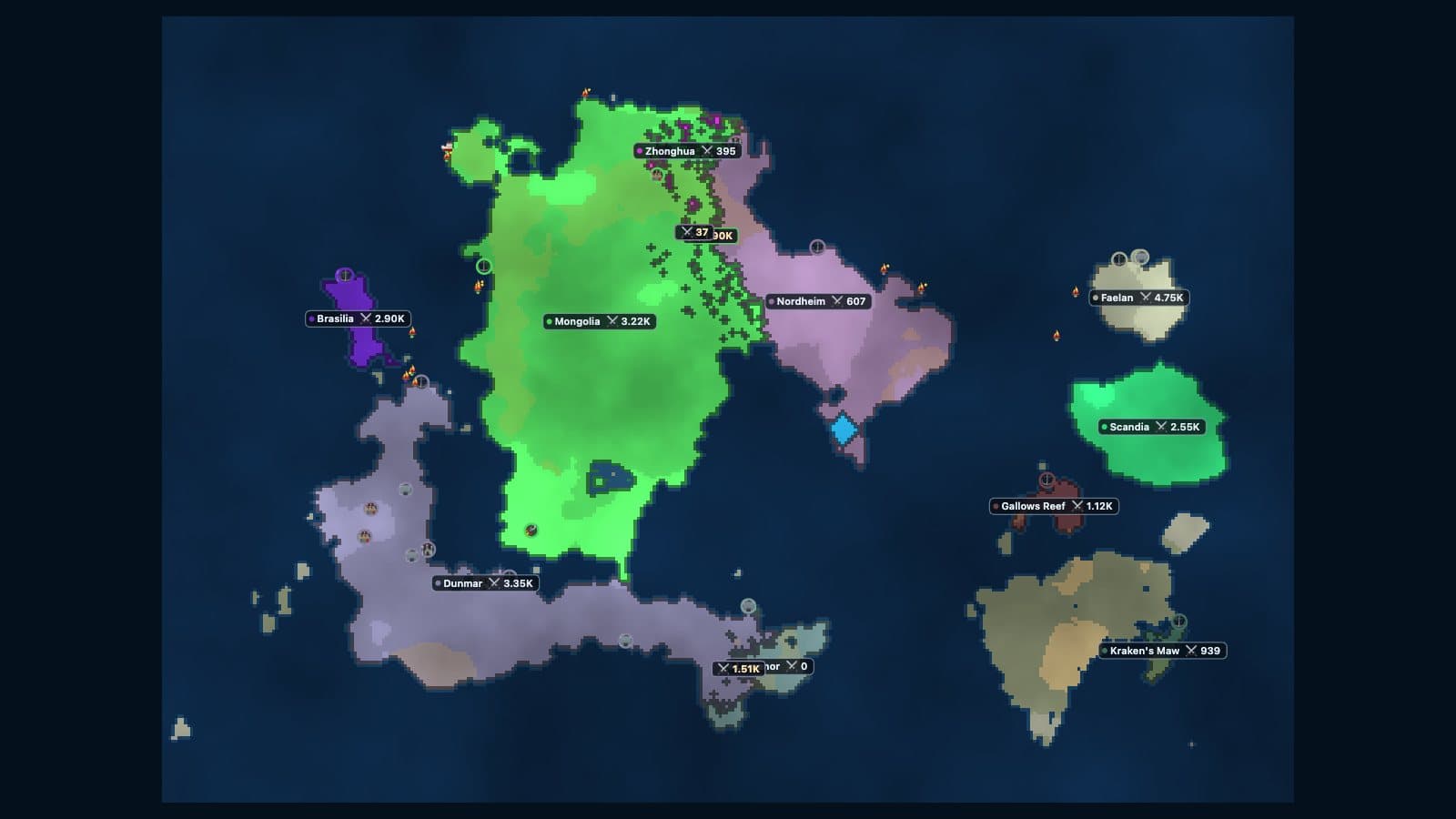
Warships protect income, transports spend it
Most of a warship's value is not fighting other navies. Any armed ship captures an unarmed trader within 3 tiles, and engages anything that is not an ally within 8. Two warships near your own harbor keep your traders alive, and a trader is the best payback in the build list. The trader post has the income, the build-order post has where ports fit among cities and factories.
A transport is the other kind of ship: unarmed, 28 hit points, which one warship sinks in 0.7 seconds. You pick a landing tile, it loads the troops from your population, sails and lands. The landing removes 0.5 population from the defender per landed troop, then launches an attack with the troop count times 1.6. The ship is used up in the landing.
| Troops loaded | Defender loses on landing | Attack launched ashore |
|---|---|---|
| 1,000 | 500 | 1,600 |
| 3,000 | 1,500 | 4,800 |
| 5,000 | 2,500 | 8,000 |
| 10,000 | 5,000 | 16,000 |
Crossing 40 tiles takes 6.7 seconds and 100 tiles takes 16.7, so the exposure is short, but the armed ship that finds it first wins. An escort is cheap insurance: one warship costs 2.5 transports. If the sea route does not exist, the troops return and half of the 1,000 gold is refunded.
What the AI does, and what OpenFront does
On Easy the AI builds no ships. On Normal and Hard it does, so a coast you leave empty gets visited. We make Frontlines and CONQUEST and are not affiliated with anyone else mentioned here.
For contrast, OpenFront (an open-source game; see its repository) prices each new warship 250,000 more than the last, capped at 1,000,000 in its configuration units, makes transport ships free, and has no carrier in its cost table. Frontlines does the opposite: a flat price, a hard per-port limit, a carrier as the premium item. If you like naval play that scales with how many ships you buy, OpenFront is the place for it.
A sensible order
Port first, two traders, then two warships at the harbor. Add a second port before a first carrier: it raises every limit, and its 3,750 gold is less than a third of a carrier. Buy a carrier when you have idle gold and an enemy coast that troops cannot crack. Keep transports in the dock until you know where the enemy is thin, then send one with a warship alongside. You can try each of these in a solo match at playfrontlines.com, and the FAQ lists the keys. When the gold goes into missiles instead of ships, the SAM post covers the defense.
More from the blog.
How Many Troops to Conquer a Nation in Frontlines
Send about 1.5 to 1.75 times a nation's troops. Enemy land costs 4 to 19 troops per tile against 1 for empty land. The numbers, from the game code.
Oct 06, 2026 · 6 min
Frontlines Trade Ships: How Much Gold a Trader Earns
A trader costs 800 gold and earns about 830 gold a minute on a typical 120-tile route. Payback, the port ladder and the catch, replayed from the game code.
Oct 15, 2026 · 6 min
How Alliances Work in Frontlines, and What Betrayal Costs
A solo alliance lasts 10 minutes. Leaving gives a 5-minute truce, betraying makes you 35% easier to conquer for good. Every number from the game code.
Oct 13, 2026 · 5 min