CONQUEST Capitals Mode: 4 Players Finish in 9 Rounds
Capitals mode ended 4-player World games in 9 rounds instead of 32. How the capital is picked, why it starts exposed, and how to play for it.
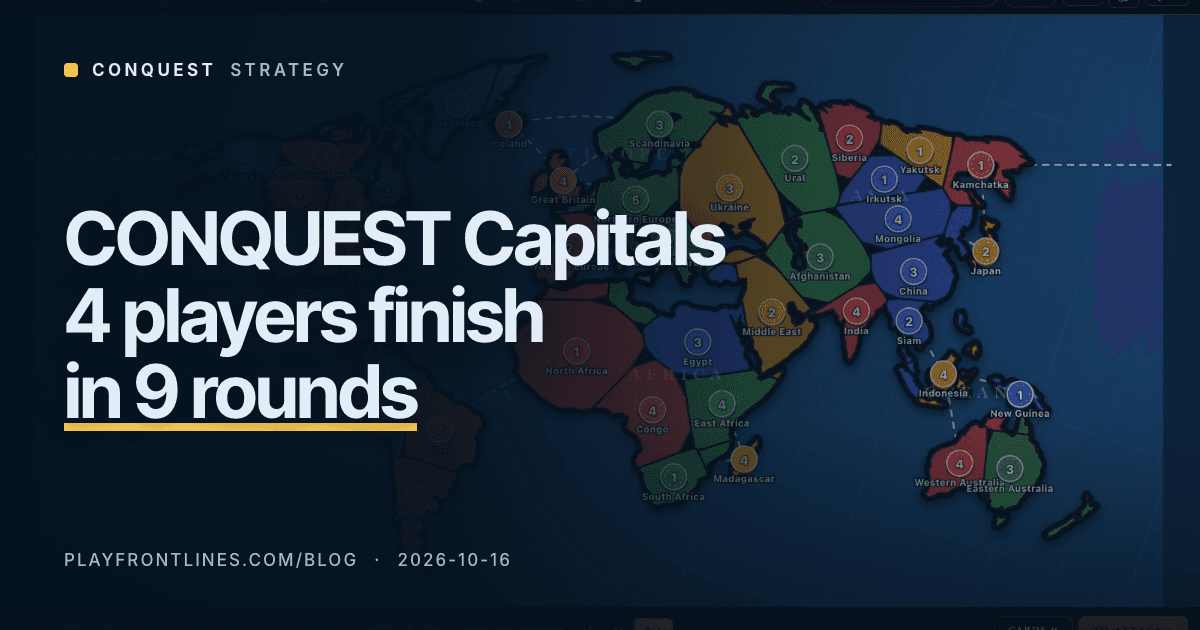
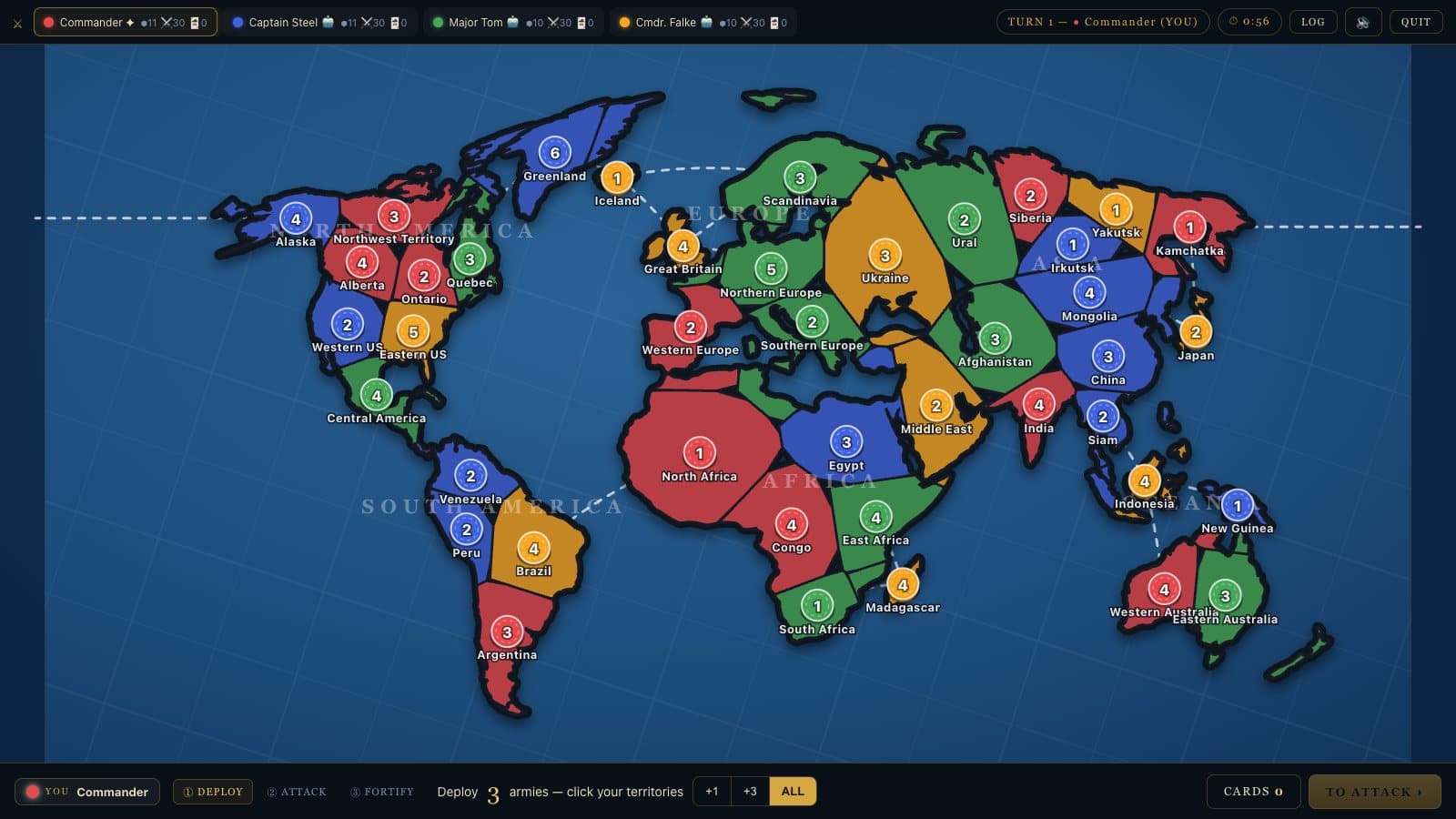
In CONQUEST's Capitals mode you win by holding every capital on the board at once, yours included. You do not have to eliminate anyone.
That one change makes the game far shorter. In 200 paired four-player games on the World map, the median game took 9 rounds in Capitals mode and 32 in World Domination. On the other maps we tried it was a third as long or less.
CONQUEST is a RISK-style game and is not affiliated with Hasbro, the maker of RISK. Everything below comes from the game's rules engine in shared/engine.js and from bot-only games run on that engine.
The capital is picked for you, and it is the middle of your land
With auto-deal, the engine looks at the territories you were dealt and picks the one with the most neighbours you also own. That is your capital. With a manual draft, the first territory you claim becomes it.
The choice is public. Every player sees every capital, marked with a star, from the start, and the game tells you which one is yours.
In the real tabletop game it is different. The Risk FAQ kept at the University of Kent describes the capitals variant as one where each player secretly picks a territory and the choices are revealed together, and a Hasbro RISK rulebook (model B7404, hosted on ManualsNet) has you pick a hidden Headquarters and win by capturing all the opposing ones. In CONQUEST nothing is hidden, so there is nothing to bluff and every bot and human knows where to aim.
Two details of the CONQUEST rule decide how games end:
- You must hold all of the capitals, not only your enemies'. Your own counts. If someone takes your capital, you cannot win until you take it back.
- A capital is a place, not a status. It stays on the same territory for the whole game, whoever owns it now.
Losing your capital does not eliminate you. The rule is the same as the one the Kent FAQ gives for the board game: "If you lose your capital, you are not out of the game."
A capital defends exactly like any other tile
There is no capital rule in the attack code. A capital rolls the same two defending dice as the territory next door, and the dice odds apply unchanged. Region bonuses and card trade-ins are unchanged too. Your reinforcements are still your territories divided by 3 (minimum 3) plus the bonuses for regions you own whole, as the continent guide explains.
What changes is what the board is for. Tiles matter for two reasons now: they feed you armies, and they are the road to a star.
The start is crowded, and a capital usually falls in round 1
We dealt 200 four-player games on each of three maps and looked at the capitals before anyone moved.
| Map | Neighbours of a capital | Enemy-held at the deal | Armies on it | Deals with two capitals touching |
|---|---|---|---|---|
| World (42 territories) | 5 | 3 | 3 | 36% |
| Europe (27) | 5 | 3 | 4 | 55% |
| USA (39) | 6 | 3 | 3 | 53% |
All figures are medians except the last column. On Europe and the USA, in more than half of the deals two capitals are direct neighbours at the start. In the median game on each of the three maps, the first capital changed hands during round 1.
So the opening is not a slow build. Your capital begins with about three armies and three enemy neighbours, and every one of those neighbours has a star to chase.
Capitals games are far shorter on every map
We played the same seeds twice, once with each win condition, using Hard bots, Wild Dice and auto-deal. The bots are the ones from our bot difficulty breakdown. A round is one full pass of every living player.
| Map and players | World Domination, median rounds | Capitals, median rounds | Capitals, middle 80% of games |
|---|---|---|---|
| British Isles, 4 players | 8 | 4 | 2 to 8 |
| Europe, 4 players | 14 | 5 | 2 to 10 |
| Africa, 4 players | 16 | 6 | 2 to 10 |
| USA, 4 players | 25 | 7 | 2 to 13 |
| World, 4 players | 32 | 9 | 3 to 14 |
| World, 6 players | 37 | 11 | 7 to 23 |
| World, 2 players | 13 | 2 | 1 to 4 |
The last column is the 10th to the 90th percentile. A few Domination games never finished inside the step limit of our script, 9 of 200 on Europe for example, and are left out of the Domination medians, which makes Domination look shorter than it is.
At the default 60 second turn timer, 9 rounds cost you at most 9 minutes of your own turns. The other seats' turns add to the wall clock, and human opponents are slower than bots, so treat that as a floor for the length of a table, not an estimate.
Two players is a duel over one territory
With two players, you already hold your own capital. The only thing missing is the other one. The median game lasted 2 rounds, and at least one game in ten was over in the first round.
That makes the starting seat count for a lot. Seat 1 won 72.5% of 200 two-player Capitals games, against 75% in World Domination. Moving first is worth about as much in either mode, and the first-player post goes through why. In a two-player Capitals game the other seat has one turn to prepare before the first star is under attack.
With three or more players the picture is flatter. On the 4-player World map the seats won between 20% and 29% of games, which is within the noise of 200 games.
British Isles is the exception worth knowing. Seat 4 won 35% of the games there, and seat 4 also won 33% in World Domination on the same map. The map has 18 territories, so a four-way deal gives the first two seats 5 tiles and the last two 4. Whether that explains the edge we did not test.
The winner holds about half the map
Nobody wins by wiping out the table. In 200 four-player games on the World map the winner held a median 52% of the territories when the game ended, and at least one rival was still alive in 98% or more of the games. On Europe and the USA the median was 52% and 51%.
British Isles runs higher, 67%, because 18 tiles leave less room between the stars. On the 6-player World map it is 67% too.
| Map and players | Winner's share of the map, median | Winner's share, middle 80% |
|---|---|---|
| World, 4 players | 52% | 33% to 79% |
| Europe, 4 players | 52% | 37% to 78% |
| USA, 4 players | 51% | 33% to 77% |
| British Isles, 4 players | 67% | 44% to 89% |
| World, 6 players | 67% | 48% to 86% |
A sensible reading: do not spend armies on a distant, harmless corner just because the region bonus looks nice. Every attack should either feed your reinforcements or open a path to a star.
Keep your own star, because losing it is expensive
We checked who held their own capital at the start of round 4. In four-player games, players who had already lost theirs went on to win far less often than a fair 25%.
| Map, 4 players | Won, capital held at round 4 | Won, capital held by someone else |
|---|---|---|
| Europe | 38.2% | 16.7% |
| British Isles | 38.0% | 18.2% |
| USA | 34.2% | 17.7% |
| Africa | 32.7% | 20.1% |
| World | 30.0% | 19.8% |
The bots behave as if they know this. In shared/bots.js a bot that plans (Medium, Hard and God Mode) puts its reinforcements on its capital first when enemy armies next to it outnumber the garrison. Every bot adds a bonus when ranking an attack on someone else's capital, 0.6 for Easy and Medium and 1.3 for Hard and God Mode. The two hunting levels will launch that attack from as little as one army per defender, where they would otherwise wait for 1.3 or 1.05. Against a Hard bot, expect your star to be a target from turn one.
A practical order of play that follows from the numbers:
- Look at the map before you place. Count the enemy tiles around your star and check whether another star is within one step.
- Put the first reinforcements where the star is thin. With about three armies and three enemy neighbours, one extra stack is the cheapest insurance on the board.
- Take a neighbouring star early if it is adjacent. On Europe and the USA that is the case in about half of the deals.
- Stop expanding once the route is clear. The stars are the target, and the winner needed half the map, not all of it.
You can try the mode against bots in the setup screen of CONQUEST, where the win condition is the drop-down labelled Capitals, and the CONQUEST rules page has the rest of the options. Cards work as in World Domination, and when to trade them in is covered in its own post.
More from the blog.
RISK-Style Browser Games: Which Need No Account?
Five RISK-style games you can play online, checked on their own sites: who asks for an account, who has bots, and how long a 2-player game runs.
Oct 18, 2026 · 5 min
CONQUEST Bots: What Easy, Hard and God Mode Really Do
Easy bots won 5% of mixed games, Hard and God Mode 36% each. What each CONQUEST bot level attacks with, when it gives up, and how to beat it.
Oct 14, 2026 · 6 min
Which Continent to Take First in CONQUEST (World Map)
Oceania and South America each pay 2 armies a turn for about 9 expected losses. Oceania has one door. All six regions of the World map, computed.
Oct 08, 2026 · 6 min